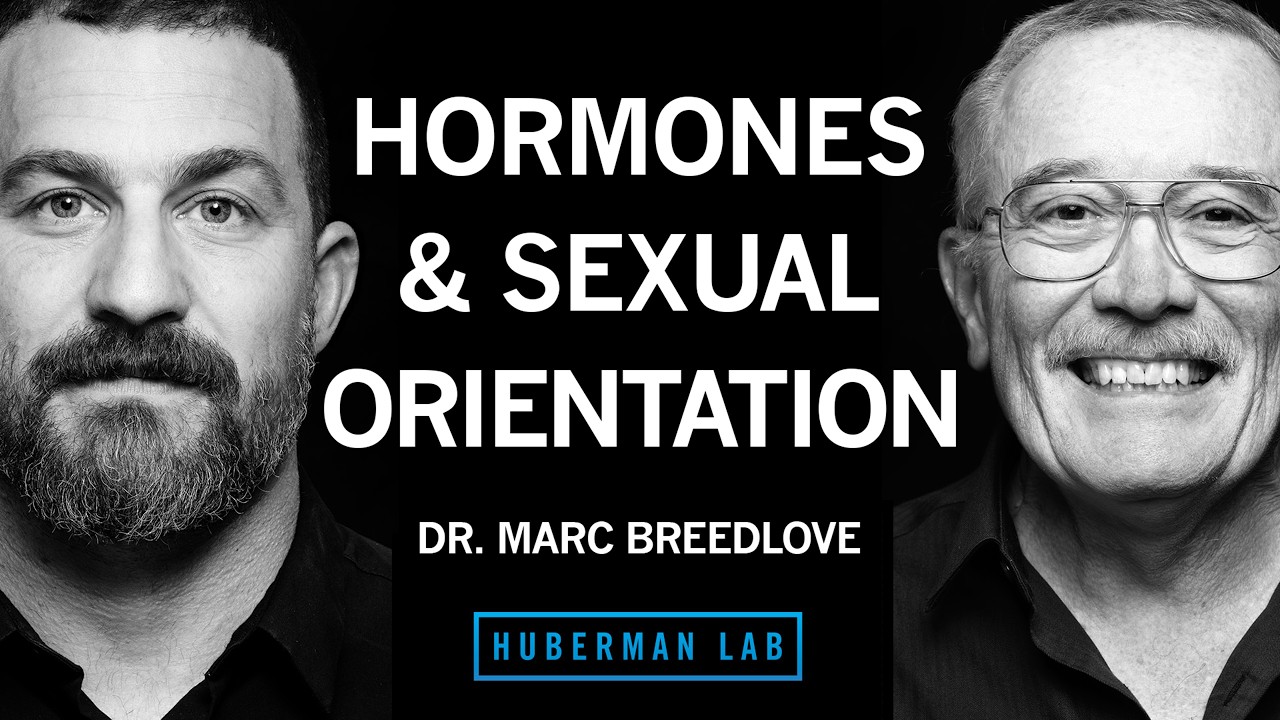
How Hormones Shape Sexual Orientation & Behavior
Dr. Marc Breedlove explains how prenatal testosterone shapes sexual orientation,
Dr. Marc Breedlove explains how prenatal testosterone shapes sexual orientation, the fraternal birth order effect, gay rams, brain sexual dimorphisms, and why sexual orientation is…
Why This Episode Matters
Prenatal Testosterone — hormones before birth shape who you're attracted to years later, leaving measurable body traces
Gay Rams — male sheep that never mount females — biological basis of partner preference in animals
Fraternal Birth Order — each older brother raises a boy's odds of being gay by ~33% via the mother's body
Brain Dimorphisms — a nucleus the size of a grain of sand differs between gay and straight men — replicated independently
Attraction AND Aversion — orientation isn't just who you're drawn to — there may be active aversion circuits
Nature ≠ Destiny — multiple developmental pathways; no single cause — but biology clearly has a say
The 2D:4D Digit Ratio
In 1999, Breedlove read a paper showing a sex difference in finger length ratios present in 9-year-old children — before puberty.
- 2D:4D ratio = index finger length ÷ ring finger length
- Tends to be smaller in men than women (ring finger relatively longer)
- More pronounced on the right hand
- Present before puberty → almost certainly due to prenatal testosterone
"A sex difference in the body that's present before puberty. I know enough about sexual differentiation of the body, it's almost certainly due to prenatal testosterone."
The Street Fair Study
Breedlove's team took their research to the streets of the San Francisco Bay Area — quite literally.
Method
- Street fairs in the Castro (gay men), Solano/Oakland (lesbians), and mixed events
- Anonymous questionnaires + hand photocopies
- Incentive: $1 lottery scratcher tickets
- Breedlove measured all digits himself — twice
Key Findings
- Gay vs straight men: no significant difference in digit ratios → similar prenatal testosterone
- Lesbians vs straight women: lesbians had more masculine digit ratios — replicated by multiple labs worldwide
- Implication: lesbians on average exposed to slightly more prenatal testosterone
"It was the least expensive experiment I'd ever done in my life... 'Please, I'd like 750 $1 lottery scratcher tickets.'"
Don't Panic: Group Stats vs. Individual Prediction
The Height Analogy
- Sex difference in height: 2 standard deviations apart
- If you guess sex from height alone, you're right ~80% of the time
- Still wrong 20% of the time — and that's the biggest sex difference
The Digit Ratio Reality
- Sex difference in 2D:4D: only 0.5 standard deviations
- A quarter the size of the height difference
- Other factors also influence digit ratios
- Zero predictive value for any individual
"Look at the right hand, pay really careful attention... and no matter what you see, guess straight and you will be right 95% of the time."
Otoacoustic Emissions: The Ear Evidence
What Are They?
- Your ears make tiny popping sounds you can't perceive
- Detectable with sensitive microphones in soundproof rooms
- Help you focus on the sounds you want to hear
- Sex difference present at birth: girls produce more
McFadden's Discovery
- Compared straight men, gay men, straight women, lesbians
- Lesbians had fewer otoacoustic emissions than straight women
- Shifted toward the male pattern
- Present at birth → can't be social learning
- Best explanation: lesbians exposed to more prenatal testosterone
This was 1998. Breedlove had spent decades writing NIH grants claiming early hormones "may be important for human behavior" — but privately never believed it. McFadden's paper changed everything.
Simon LeVay's Brain Study
Simon LeVay, an already respected neuroscientist, examined the preoptic area of the hypothalamus in gay vs. straight men.
- A nucleus there (INAH-3 / SDNPOA) is larger in men than women in rats and humans
- In gay men: the nucleus was smaller than in straight men
- Not significantly different from the size in women
- Replicated by William Byne's group — despite their skepticism
Chicken-and-egg problem: Were they gay because of a smaller SDNPOA? Or did the SDNPOA shrink because they were gay? The adult brain changes all the time — we can't assume causation from a post-mortem snapshot.
The Romeo Rat & 60 Minutes
Breedlove on CBS's 60 Minutes — demonstrating how neonatal castration permanently changes sexual behavior.
Step 1
Drop a receptive female in with Romeo (experienced male rat). He mounts, she shows lordosis. Textbook.
Step 2
Drop a control male in. Romeo mounts him several times. The control male acts like nothing is going on. Romeo gives up.
Step 3
Drop in a male castrated at birth + given female hormones. Romeo mounts — and gets beautiful lordosis. Permanent behavioral change.
Humans Are Different: Partner Identity Matters
"We're overwhelmingly interested in who our partner is. That is an overriding concern that I don't think my rats have."
Animals
- Motor patterns well-studied (lordosis, mounting)
- Rats don't have partner preference — Romeo mounts anything
- We know motor circuits well, much less about motivation
Humans
- Biggest sex differences are in sexual attitudes, not cognition
- Gay men are "totally masculine" in these attitudes
- The real question: who is the partner, not what acts occur
Thought experiment: half the planet finds George Clooney an ideal partner; the other half finds him totally unacceptable — even though the behaviors would be the same.
Gay Rams: Real Orientation in Animals
Chuck Roselli at Oregon discovered that ~8% of rams never mount females and exclusively mount males.
- Shepherds have known this for ages
- In controlled tests: a gay ram placed with a dozen receptive females for 12 hours — never mounts a single one
- Full intromission and ejaculation with males
- Not a lack of opportunity — it's an active aversion to females
"I'm going to call them gay rams. I think they have an orientation."
The kicker: Roselli found a difference in the preoptic area of gay vs. straight rams — the same brain region LeVay found different in gay vs. straight men.
The Aversion Hypothesis
The Push-Pull Model
Across neuroscience: flexor/extensor, hunger/satiety, attraction/aversion
- Gay rams don't just prefer males — mating with females appears aversive
- In heterosexual men: the idea of same-sex mating is often actively aversive, not just neutral
- This mirrors the push-pull architecture seen throughout the brain
Sex Difference in Plasticity
- Women are more plastic in sexual orientation
- More women report bisexuality; some shift orientation over their lifetime
- Huberman's hypothesis: men may have a stronger aversion circuit; women may lack it or have a weaker version
- Breedlove's response: "Your hypothesis fits the data"
Why this matters: Understanding the aversion pathway is as important as understanding attraction for making sense of human sexuality — and for advancing the conversation past politics.
Fraternal Birth Order Effect
One of the most replicated findings in human sexuality — first noticed by Ray Blanchard at Toronto.
| Older brothers | Probability of being gay |
|---|---|
| 0 | ~2% |
| 1 | ~2.6% (+33%) |
| 2 | ~3.5% (+33%) |
| ... | linear increase |
| ~12 | ~50% |
For straight men: 105 older brothers per 100 older sisters (matches birth ratio). For gay men: 140 older brothers per 100 older sisters.
Blanchard estimates about one in seven gay men are gay because their mother carried brothers before them.
It's Not Social — It's the Mother's Body
What Doesn't Matter
- Step brothers: no effect on orientation
- Older sisters: no effect
- Younger brothers: no effect
- Being raised together or apart: no difference
- Dad leaving the household: no correlation found
What Does Matter
- Biological older brothers from the same mother — even if raised apart
- It's the mother's body "remembering" how many sons she carried
- The effect is biological, not socially mediated
- Each delivery of a son exposes the mother's immune system to male-specific antigens
This finding inverts the folk explanation: people assumed having older sisters or a missing father might make a boy gay. The biology says the exact opposite — it's older brothers that matter, via an immunological mechanism.
Maternal Immunization Hypothesis
The Blanchard-Bogaert mechanism that explains how older brothers increase the probability.
- First son in utero → mother's immune system never encounters Y-chromosome antigens
- At birth → blood mixing → mother's immune system sees male-specific antigens for the first time
- Antibodies generated → specifically to neuroligin-4Y (a synapse formation protein on the Y chromosome)
- Next son → maternal antibodies cross the placenta and may perturb brain development
- Each subsequent son → more antibodies → incrementally higher odds
Women whose later sons showed the pattern have higher levels of antibodies to neuroligin-4Y — a male-specific synapse protein.
CAH: Congenital Adrenal Hyperplasia
The Mechanism
- Fetus can't make certain adrenal steroids
- Brain tells adrenal glands to produce more
- Adrenals hypertrophy but can't make the right steroids
- Instead they produce testosterone and other androgens
- In XX individuals: intersex phenotype at birth
Sexual Orientation in CAH Women
- More likely to be same-sex attracted than the general population
- But most are still straight
- The older they get, the higher the percentage reporting lesbian orientation
- Consistent with prenatal testosterone increasing the odds of attraction to women
Heterozygous carriers (one mutant copy) are surprisingly common: 1 in 12 people. They may have subtle phenotypes — slightly more androgens, altered stress response — but it's not well studied.
AIS: Androgen Insensitivity Syndrome
The Biology
- XY individual with a dysfunctional androgen receptor (gene on X chromosome)
- Testes form, release testosterone — but the body can't respond
- Anti-Mullerian hormone suppresses female duct development
- External appearance: typically female
- Often undetected until puberty (no period)
The Orientation Question
- Vast majority grow up attracted to men — very feminine, often interested in having families
- But: are they straight because their brain never responded to testosterone? Or because they were raised as girls?
- AIS can't disentangle nature from nurture here — both explanations fit
- A frustrating limitation for researchers
With no testosterone response, AIS individuals often have very feminine faces and bodies. At least one woman with AIS is a successful model; another wrote a well-known memoir.
Gynandromorphs: When One Side Is Male
The Phenomenon
- In cardinals: one side bright red (male), other side dull (female) — split down the middle
- Two embryos (one male, one female) fused at early stage
- In mammals, gonads would masculinize everything via hormones
- But birds stay split → gonads aren't running the show
The Implication
- Art Arnold showed brain sex differences were also split by side in gynandromorphs
- In birds: the brain itself makes hormones locally and masculinizes itself
- Genetic sex of the brain directly determines local hormone production
- This is why Breedlove's head-transplant experiment (male brain on female body) would not have been informative
Nicole LeDouarin pioneered chick-quail chimera experiments — transplanting nervous system tissue between species. White leghorn chickens with a streak of brown quail-derived feathers confirmed the technique worked.
Brain Plasticity: More Than We Thought
Breedlove's observation from decades of Society for Neuroscience meetings:
"Every year when I went to the neuroscience meeting, the brain was more plastic than it was the year before."
Key insights from the discussion:
- The neocortex is probably more plastic than the hypothalamus — but the hypothalamus is far from hardwired
- POMC neurons in the arcuate nucleus show late-stage plasticity (hunger circuits)
- Brad Cooke showed testosterone removal can erase a sex difference in the medial amygdala in weeks
- Julian Davidson at Stanford showed testosterone replacement in castrated men reliably improved mood and libido — they always knew when they were getting the real thing
The Fetal Rate of Growth
"Human beings, children are fetuses that are outside learning a whole bunch of stuff from other people. That's the real distinctiveness of our species."
Human vs. Chimp Brain Growth
- Until birth: brain growth rate roughly equal in humans and chimps
- After birth: chimp brain growth slows and asymptotes
- Human brain continues at fetal rate of growth until age 6-10
- This extended window = massive social learning capacity
What This Means for Orientation
- The brain remains hormone-sensitive for years after birth
- Behavior affects testosterone; testosterone affects the brain
- Winners of competitions get testosterone boosts; losers don't
- Even presidential election outcomes shift voters' testosterone levels
Nature vs. Nurture: The English Analogy
"I speak English... I don't remember learning English and I certainly didn't choose to learn English, but I'm sure that it's English because of social influences."
Biology Says
- Prenatal testosterone matters (digit ratios, otoacoustic emissions)
- Maternal immune response matters (fraternal birth order)
- Brain structure differs (SDNPOA/INAH-3)
- Present from birth in some markers
Social Influence
- 95% heterosexual orientation may partly reflect a "heterosexual world" (Disney, culture)
- Culture can amplify or reduce expression of aversion
- Rough-and-tumble play: biological; most other masculine behaviors: culturally shaped
The Bottom Line
- Researchers looked hard for social correlates of orientation — missing fathers, coddling mothers, etc.
- The data simply aren't there
- Multiple pathways; no single cause
- Not a choice — that much is clear
Rough-and-Tumble Play: The One That Persists
Across Species
- Males engage in much more rough-and-tumble play — rats, monkeys, humans
- Related to testosterone exposure
- Melissa Hines showed even monkeys prefer sex-typed toys: males go for wheeled toys, females for dolls
- Mixed groups: girls calm boys down, boys ramp girls up
In Breedlove's Own Family
- His daughter Tessa wanted to wear dresses every day — despite her neuroscientist mother never wearing them
- One of his boys "could make a gun out of anything" — even growing up in Berkeley where toy guns were impossible to find
"The more kids people had, the more they thought nature was important."
Rough-and-tumble play is probably the one sex difference that will persist regardless of cultural shifts — almost certainly biological in origin.
The Trenbolone Observation
The Anecdotal Pattern
- In anabolic steroid communities, trenbolone in particular is reported to cause:
- Increased aggression
- Hypersexuality
- Self-reporting heterosexual males wanting to have sex with males or females
- Effect appears reversible when they stop
- Not controlled studies — but thousands of consistent reports
What It Suggests
- The adult hypothalamus is still androgen-sensitive enough to drive powerful changes in sexual behavior and perception
- Julian Davidson's Stanford studies confirmed: testosterone replacement in castrated men reliably affects mood, energy, and libido
- Testosterone levels vary enormously between individuals — a man in his 70s can have levels comparable to someone in their 20s
This is distinct from normal testosterone replacement therapy. The observation suggests that at supraphysiological doses, specific androgens may temporarily alter the adult brain's orientation-related circuitry.
From the Ozarks to Yale
Background
- Born in the Ozarks — "hill country," like Appalachia in terrain and culture
- Raised by grandparents: construction worker + food processing plant worker
- They'd completed about third grade between them
- Only income after grandfather passed: Social Security
The Lucky Break
- School librarian showed him the College Board's first-ever guide
- He read the entire book — only the financial aid paragraphs
- Yale's entry: "we're committed to making sure everyone admitted will get the financial aid they need"
- He'd never heard of Yale — "I associate it with locks"
"The older I get, the more I realize how much luck matters."
The Yale Years: Soak It Up
Culture Shock
- Roommates from prep school; one with a famous family name
- They start smoking marijuana on the first night
- In Breedlove's home county, a judge had just sentenced someone to life in prison for marijuana possession
- "I'm not in the Ozarks anymore"
The Right Attitude
- "They've made a mistake... Mrs. Fischer got me in and I'm not going to screw this up"
- Wanted to take 6 courses (limit was 5)
- Didn't care about grades — wanted to learn everything
- Half of what he learned came from other students
- Discovered neuroscience through comparative psychology
"I never felt the pressure to be the smartest person in the room... I regarded everyone there as they certainly knew more than I did."
The First Crush Exercise
Breedlove asks every class to remember their first crush — and uses it to demonstrate that orientation isn't a choice.
Breedlove's Story
- Age 6 or 7
- Marilyn Monroe on TV — a close-up
- "Afterwards, I'm just so agitated... I had a hard time going to sleep"
- Knew nothing about sex
- Didn't choose to have that reaction
The Pattern
- Almost always before puberty — so puberty isn't the cause
- The sex of the first crush tends to predict lifelong orientation
- Huberman: "It's been constant" — his first crush at age 6
- No one decides to feel this way
- "Sexual orientation is not a choice"
The time lag is the truly strange part: something that happened before birth shapes a feeling that doesn't emerge until age 6-10. As Breedlove puts it — this was like "a visitation."
Core Quotes
"It's really one of the rock solid findings in human sexuality."
— on the fraternal birth order effect
"I don't think my rats have an orientation."
— on why animal models can't fully capture human sexuality
"Human beings, children are fetuses that are outside learning a whole bunch of stuff from other people. That's the real distinctiveness of our species."
— on the fetal rate of brain growth
"Every year when I went to the neuroscience meeting, the brain was more plastic than it was the year before."
— on neural plasticity
"I'm going to call them gay rams. I think they have an orientation."
— on rams that never mount females
"They've made a mistake... I'm not going to screw this up."
— on arriving at Yale from the Ozarks
Thank You
"Sexual orientation is not a choice... There's no one cause of any human behavior."
Dr. Marc Breedlove — professor of neuroscience, Michigan State University
Huberman Lab Podcast