The "Inverse Problem" Of Dark Matter Is Insane
Dr. Jenny Wagner explains why gravitational lensing data only constrains local
Dr. Jenny Wagner explains why gravitational lensing data only constrains local properties of mass distributions, making every grand dark matter map a model-driven extrapolation. Sh…
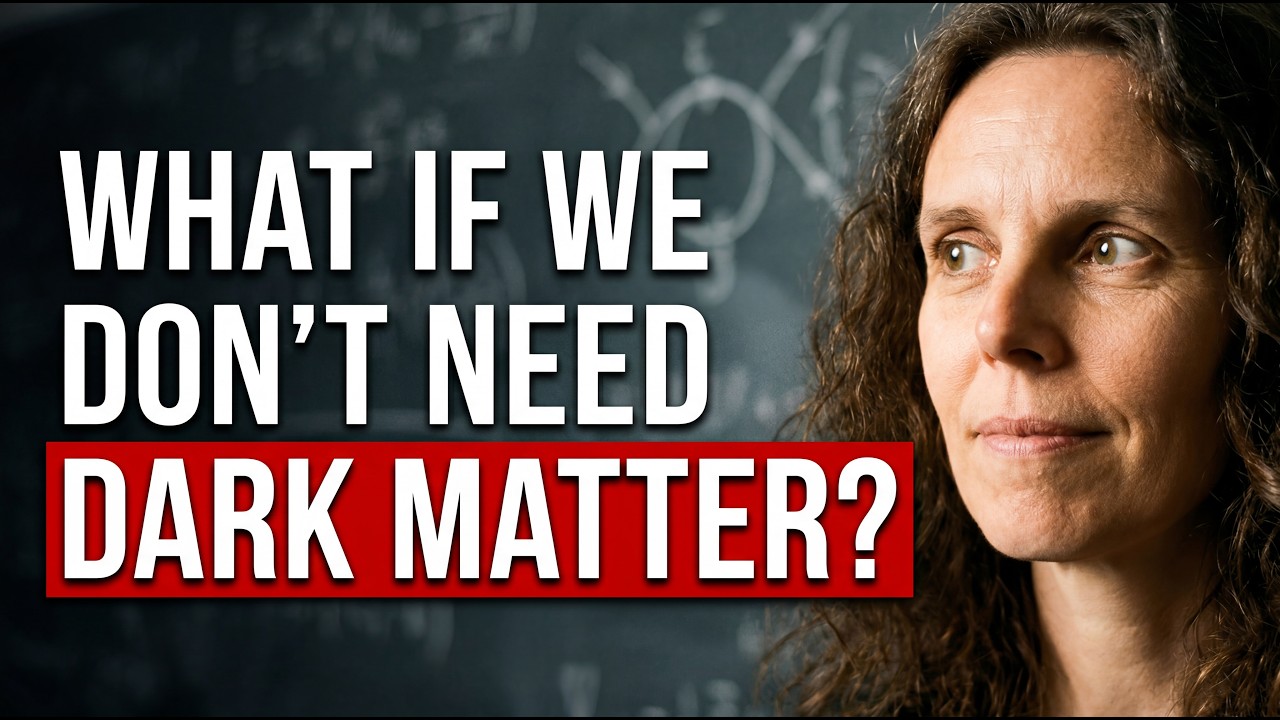
Why This Episode Matters
The Inverse Problem — gravitational lensing data only gives you local information; every grand dark matter map is model-driven extrapolation
Forward vs Inverse Modeling — the community loves forward models, but nature hands us data and we must work backwards — like a detective, not a fortune-teller
Model Dependence — converging "evidence" from CMB, rotation curves, and the Bullet Cluster shares a large overlap of the same assumptions
Cosmological Principle in Trouble — multiple 5σ anomalies suggest the universe may not be as homogeneous and isotropic as assumed since 1917
AI Can't Save Cosmology (Yet) — Wagner applies Hassabis's three criteria and finds cosmology fails all three prerequisites for a successful AI application
A New Scientific Method — inverse problem solving as a tree of necessary knowledge: lower risk, fewer resources, and you never fall back to square zero
What Is Dark Matter?
85% of the universe's matter is supposedly missing. But what does that actually mean?
- We see cosmic structures — galaxy clusters, gravitational bonds — that should fly apart given the visible matter alone
- The luminous, baryonic matter we observe is too little to keep structures together
- Without dark matter, these structures would dissolve over cosmic time
The scale: not a small discrepancy — 85% of the entire matter content seems to be missing. We can't explain it away with faint gas or small planets.
Visible Matter
Dark Matter
Wagner's Question
Gravitational Lensing: The Chicken-Egg Problem
Strong gravitational lensing is a powerful probe because it relies purely on general relativity — heavy masses curve spacetime, bending light along null geodesics.
The problem: it creates multiple distorted images of the same background source.
- If we knew the lens perfectly → reconstruct the source
- If we knew the source perfectly → reconstruct the lens
- In cosmology, we know neither
"It's a chicken-egg problem. We neither know the source, nor do we know the lens."
Wagner's Core Thesis
"Local evidence, and I would say global extrapolation."
When Curt summarized her position as "data constrains local information; everything else is model-driven extrapolation," Wagner responded:
"You got it 100% right. That's exactly how you describe it."
Where you have data → you have information (local lens properties: distortion directions, relative magnification)
Where you don't have data → you have extrapolation, speculation, prediction — however physically informed
Forward vs Inverse Modeling
Wagner's key methodological distinction — and the heart of the episode.
Forward modeling: start with a cause, predict effects. Easy, intuitive, everyone does it. But if nature says "no," you're back to guessing a different model.
Inverse modeling: start with what you see, reason backwards to the necessary model. Harder mathematically, but you only commit to what the data requires.
"I'm CSI cosmology if you want to see it like that."
The Broken Mug Analogy
Forward Approach
You try to model everything: Was it the dog? The kid? The husband? What time? What trajectory?
Each wrong guess sends you back to square zero.
Inverse Approach
The mug is broken on the floor. Necessary conclusion: it fell from the table.
If you guess the culprit wrong, you only fall back one level — not to the ground.
The analogy to cosmology: we see gravitational lensing effects (the broken mug). The necessary conclusion is local lens properties. Who or what caused the mass distribution (dark matter? modified gravity?) is a separate, higher-level question — and getting it wrong doesn't invalidate the local data.
The Condo and Dark Tenants Analogy
The Setup
Imagine modeling a condo building's foot traffic by measuring doors opening and closing. Your model includes residents' work schedules, visitors, the concierge...
The doors open more than your model predicts. Do you postulate invisible occupants — "dark tenants"?
The Problem
Look at how many parameters you put in: work schedules, family sizes, visitor patterns. If you're wrong by a factor of two on just one estimate, your model is completely off.
The inverse approach: just understand how the door works. That's a much easier problem.
"If you just with one estimate you're a bit off, this adds up. And this is... all of this forward modeling is really fragile."
Model Dependence: The Uncomfortable Truth
"We are not short of models."
The Critic's View
We have converging evidence from simulations, rotation curves, the CMB, the Bullet Cluster. How can you say this is "just model-driven"?
Wagner's Response
Most of these probes share a large overlap of the same assumptions. They use the same limited set of reasonable models, filling data gaps with model assumptions.
Analytical era
Numerical era
Heuristic fitting
MOND vs Dark Matter: Neither Fully Refuted
Dark Matter Camp
- Particle physicists excited: could be a new particle (SUSY, WIMPs, axions...)
- Searched at CERN, Fermilab, direct detection experiments
- Result: no clear detection after decades of searching
Modified Gravity Camp
- Moti Milgrom's MOND (1983): modify Newton's law beyond the scale probed by Pioneer satellites
- Survived 40 years, solved some problems
- Issues: not general-relativistic, has one unexplained scale parameter
Wagner's position: both have problems, but neither can be definitively refuted by current data. She doesn't pick sides — she picks the data. Her camp: "I want the least amount of magic in my universe and the most amount of things that I can actually experience."
The Bullet Cluster: Not So Smoking
The Bullet Cluster (2004) was long considered the "smoking gun" for dark matter — two galaxy clusters colliding, with dark matter and baryonic matter apparently separated.
But a 2025 study (Sangjun Chae et al.) using James Webb infrared found:
- The merger was far more complex than two spheres colliding
- Intracluster light traced the merging structure faithfully
- The dark matter "offset" was an artifact of the simplified model
2004 Interpretation
Two spherical clumps → dark matter offset from luminous matter → "smoking gun"
2025 Reanalysis (JWST)
Complex merger with elongated arm → intracluster stars follow the structure → no clear offset
The Pattern
Better telescopes → more detail → previous "evidence" turns out to be model artifact
"This cannot be a clear hint for dark matter is offset to luminous matter."
Abell 3827: The Model-Independent Test
Abell 3827: an unusual cluster with four equally bright galaxies in the center and a nearly complete Einstein ring of lensing around them.
Forward Modeling Result
Dark matter appears offset from the four luminous galaxies — interpreted as evidence that "light does not trace mass"
Wagner's Model-Independent Result
Using star-forming regions to chop multiple images into patches, they tracked local lens properties across each patch
Finding: the offset was completely driven by the models — the lens properties were changing rapidly, inconsistent with a smooth dark matter halo
Key insight: if the mass density changes across a single multiple image, how can we extrapolate to regions far from any data point? The forward models assumed smoothness that the data did not support.
Power Laws and Scale-Free Gravity
Why power laws matter for understanding cosmic structure — and why they're philosophically interesting.
- Power law: 1/r^α — falls off slowly, never truly hits zero
- Newtonian gravity is scale-free: F = Gm₁m₂/r² — depends only on masses and distance, not on time or any other property
- Scale-freeness naturally leads to power laws
The wealth analogy: power laws describe income distribution. You can't predict a billionaire from studying millionaires — there's always a chance of surprise.
"There is no mean, there is no variance, and this means that the universe could keep on surprising us."
The DEMON Framework
DEMON = Dark Emergent Meta halo explanatiONs
The problem: standard statistical mechanics doesn't work for gravity because gravity does the opposite — instead of maximizing entropy (uniform distribution), gravity collapses everything into a point.
The Penrose Insight
Roger Penrose points out: gravity is the opposite of statistical mechanics. Entropy wants everything spread out; gravity wants everything collapsed.
Wagner's Solution
Start with Newtonian gravity's scale-freeness → derive power laws without statistical mechanics → reason why certain exponents are physically plausible
The plea: "Don't use black boxes. Simulations are important, but don't use them as black boxes and just heuristically fit. Try to get" a fundamental physical understanding of why a given model works.
Sobolev Spaces and Infinite Black Holes
When deriving lensing degeneracies, Wagner worked in Sobolev spaces — abstract function spaces from functional analysis.
The Math
In a Sobolev space, if a function is integrable, you can change it by a null set without changing the integral. A null set can be a countable set of point masses — i.e., black holes.
The Physics
A smooth gravitational potential and one riddled with infinitely many black holes (countably infinite) produce the same observable lensing signal.
The math says it's allowed. The physics asks: is it reasonable?
"Suddenly, this makes sense because this was this one sentence in one of the books on strong gravitational lensing, 'Oh, and we can also put some black holes in this potential. It doesn't matter.' And I thought, 'Where's this coming from?'"
The Breakthrough: Reading Someone Else's Thesis
Wagner's Path
Masters at CERN (particle physics) → cancer research & machine learning → astrophysics
All tied together by one thread: analyzing data under mathematical principles
The Moment
A friend's quantum chemistry thesis described molecules using local electron positions and positive ions — and Wagner saw the Laplace operator, the same functions, the same structure.
The Result
The math was identical. She went back to her math textbook and found the theorems in functional analysis to describe all lensing degeneracies.
"I saw the equations and suddenly this is my gravitational lensing problem."
Mark Gorenstein's reaction (who had been working on lensing degeneracy for decades): "Oh, finally you got it. 30 years after we found out."
Why Others Missed It
Astrophysicists Are Phenomenologists
They look at something and have physical intuition: "twice the mass means twice the lensing power." They reason from physics to equations.
Wagner Starts with Equations
She can't say much until she writes down the math. She first solved the equations, then found out they made physical sense.
Following Carlo Rovelli's principle: "You should not write down a single thing that you cannot attribute a clear physical meaning."
The reduced shear insight: the parameter "g" (reduced shear) encodes the local shearing power — its direction and amplitude — but is independent of the mass needed to produce it. You always see ratios in the equations: something divided by mass. That's the degeneracy the formalism was trying to tell everyone for 30 years.
The Spherical Cow of Cosmology
"The cosmos is much more difficult and much more complex than just a spherical cow because our cosmological standard model is a spherical cow. It's homogeneous, isotropic, so the same in every direction and the matter density is the same everywhere."
Einstein's 1917 cosmology paper made the assumption of homogeneity and isotropy — but explicitly wrote that he did not think it was true. He saw stars and voids, and hoped that with more data, we would overcome this simplified assumption.
Einstein's Hope (1917)
A starting point — the simplest possible model. With better data, the next level of detail would emerge.
Wagner's Assessment (2023)
After 100+ years, we may finally have enough data to see beyond the spherical cow. Time for the next level of detail.
Cracks in the Cosmological Principle
Wagner co-authored a 2023 review paper with 22-23 scientists collecting all hints of violation of the cosmological principle.
Key findings:
- Subir Sarkar's matter dipole: early vs late universe reference frames don't match — 5σ
- Kostas Migkas' bulk flow: galaxy clusters moving coherently in one direction — 5σ
- Giant Arc & Ring (Alexia Lopez & Roger Clowes): structures too large to have formed in standard cosmology — 3-4σ
- CMB anomalies: the "axis of evil" and other asymmetries
If Sarkar's effect is true, it's not just Λ CDM that breaks — it's the entire class of homogeneous isotropic models.
Not a Crisis — An Opportunity
"We are now ready to move on. After 100 years of the first standard model that we have, we are now ready to see the next level of detail."
The Pessimistic View
"Cosmology in crisis" — our models are breaking down, decades of work wasted, dark matter fights are never-ending.
Wagner's View
Homogeneous and isotropic is "the second most boring thing you can do." As data quality increases, you should see dipoles, preferred directions, and finer structure. That's progress, not crisis.
The key argument: particle physicists try to tear down their models — they want to be proven wrong. In astrophysics, people get attached to traditions. But after 40 years of dark matter, the data is pushing us to move on.
Penrose's Conformal Cyclic Cosmology
Roger Penrose proposes that the CMB contains concentric rings of low variance — remnants of black hole mergers from a previous universe (before the Big Bang).
The Claim
Penrose and colleagues found these rings in WMAP data (7 years). A testable prediction from a revolutionary theory about space and time before the Big Bang.
The Counter
Other teams argue: after accounting for CMB foregrounds and using different statistical baselines, the significance changes. The jury is still out.
Wagner's meta-point: this is a brilliant example of forward modeling. What do you want to believe? Penrose makes testable predictions (good), but the interpretation depends on your statistical baseline and foreground corrections. Neither confirmed nor refuted — just another theory to gamble on.
Neil Turok and the Minimalist Approach
Convergence
Both are minimalists: if detectors haven't found new particles, stick to the contents we have. Turok's right-handed neutrinos proposal is "a small extension" — reasonable, not exotic.
Wagner: "We should try to find a theory that does not use any exotic stuff."
Divergence
On the cosmological constant: Turok seeks a quantum explanation. Wagner thinks lambda came from classical theory (an invariant in GR) and should first be explained classically.
Subir Sarkar has pointed out problems with Turok's quantum approach.
The underdetermination problem (from Thomas Buchert): you split the universe into baryonic physics, dark matter, and dark energy — but with several unknowns, you can redistribute the signal between them. It's hard to definitively kill dark matter or dark energy because there's always wiggle room.
AI Can't Save Cosmology (Yet)
Wagner applies Demis Hassabis's three criteria for a successful AI application (from his Nobel lecture on AlphaFold):
- Know your feature space (and it should be huge)
- Know your goal function (what to optimize)
- Lots of training data
Does cosmology meet any of these?
"None of the three."
An AI trained on simulated lensing data achieved 95% recovery — but on real observations, rates dropped because the simulations were missing something the real universe had.
Why AI Falls Short in Cosmology
Feature Space ❌
What is dark matter? A particle? A fluid? A modification of gravity? We don't have amino acid equivalents — we can't define the building blocks.
Goal Function ❌
AlphaFold minimized free energy. What's the equivalent for GR? Mass-energy in general relativity doesn't have a unique definition. Statistical mechanics doesn't work for gravity.
Training Data ❌
DESI found 11 million galaxies — sounds like a lot, but that's less than the population of Ghana in a cosmic volume. And we can't rerun the universe.
The deeper problem: even if AI produces a model that fits the data, it's just one option of many — we already know from the inverse problem that multiple models fit equally well. A black-box model we can't physically interpret doesn't help us understand the universe.
Naked Singularities: An Unexpected Detour
At a pandemic conference, someone proposed explaining dark energy through primordial black holes repelling each other with charge — which turned out to require naked singularities.
Wagner's Plan
"It's winter break. I have nothing to do. How about I just prove this wrong in like 14 days."
She took the predicted charges and masses and forward-modeled the consequences for gravitational lensing.
The Surprise
Even naked singularities — things you'd expect to be wildly disruptive — produce Einstein rings much smaller than expected. You'd need a perfect alignment to observe any effect.
"I cannot kill this theory." — And dark matter is even harder to kill: it's just a word. See an offset? Make it collisional. Don't? Make it collisionless. The flexibility is its weakness.
A Better Scientific Method
Wagner's vision: replace gambling on forward models with inverse problem solving as the default scientific method.
Build a tree of necessary models from trunk to branches to leaves, where each level rests on validated assumptions below it.
- Lower risk: wrong at a leaf? Fall back to the branch, not the ground
- Fewer resources: higher in the tree = narrower choices = cheaper experiments
- Positive knowledge: every level is something you know, not something you guessed
"We have to rethink our scientific method completely."
Radical for Being Conservative
"What's super interesting is you're more radical for being conservative."
Wagner and Subir Sarkar aren't proposing exotic new physics — they're removing exotic assumptions. But paradoxically, this sober approach faces more resistance than speculative theories, because:
Tradition
After 40 years, people who fought for dark matter don't want to see it die. "Did we do all of this in vain?"
Human Nature
Humans want predictability and traditions. A universe that keeps surprising us "maybe there's a reason to panic."
Funding
Wagner gets rejections saying: "Nobody has done a progress in 30 years on this research direction. Why should you?"
Applications Beyond Cosmology
Cancer Research
100+ types of cancer, each with multiple signaling pathways. Forward models assume one pathway — then a patient fails treatment because there's a second pathway. Inverse modeling asks: what's the necessary ingredient to reach this state?
Particle Physics
Huge amounts of data, model dependence in triggering and reconstruction. But particle physicists have an advantage: they can rerun experiments. Cosmologists can only watch.
Criminal Investigation
Wagner's approach is literally what detectives do — start with the evidence (the effect), then reason backwards to the cause. Forward modeling is guessing suspects before examining the crime scene.
Why forward modeling dominates in experimental science: because you have agency — you can set up conditions and test predictions. In cosmology, you can't rerun the universe. That's why the inverse approach is especially important for observational science.
The Inspirations Behind the Work
Professor Willy Jaeger
Wagner's math professor in her first semesters. Taught calculus and functional analysis to a room of biologists, chemists, and physicists — always explaining what it's good for and where the proof must match reality.
George Ellis
Did his PhD with Dennis Sciama in Cambridge. Champion of inhomogeneous cosmology. Won the Templeton Prize for applying cosmological mathematics to improve conditions for underprivileged people in South Africa.
Carlo Rovelli
"You should not write down a single thing that you cannot attribute a clear physical meaning." Wagner took this to heart — first solve the equations, then find what every variable means physically.
Dennis Sciama
One of the first in modern cosmology to ask the inverse problem question. His intellectual lineage — through Ellis and the inhomogeneous cosmology community — directly informs Wagner's approach.
"What Is Gravity?"
"Academia is not the easiest way to earn money. Actually, it's the hardest, and it's the most stressful one. But this is the only reason why I'm doing this. I want an answer."
When she first heard about general relativity: gravity is a force, but it also seems to be spacetime. "It's not just like electromagnetism that lives on a background. It seems to be the background."
Her Sobolev space moment: as a student, "Who the hell needs this? Why on Earth should I care?" Years later, it unlocked the entire lensing degeneracy problem. The concept clicked when she saw its physical meaning for the first time.
Life lesson: "Don't listen to others. Make your own judgment." Wagner grew up "in the wrong bubble" and it took time to find the community — Ellis, Buchert, Sarkar — who shared her conviction that the data should lead, not the models.
Core Quotes
"Local evidence, and I would say global extrapolation."
"I'm CSI cosmology if you want to see it like that."
"Oh, finally you got it. 30 years after we found out."
"We are not short of models."
"We are now ready to move on. After 100 years of the first standard model."
"I want the least amount of magic in my universe and the most amount of things that I can actually experience."
"Don't listen to others. Make your own judgment."
Dr. Jenny Wagner
Theories of Everything with Curt Jaimungal