We Replaced Our Sales Team with 20 AI Agents
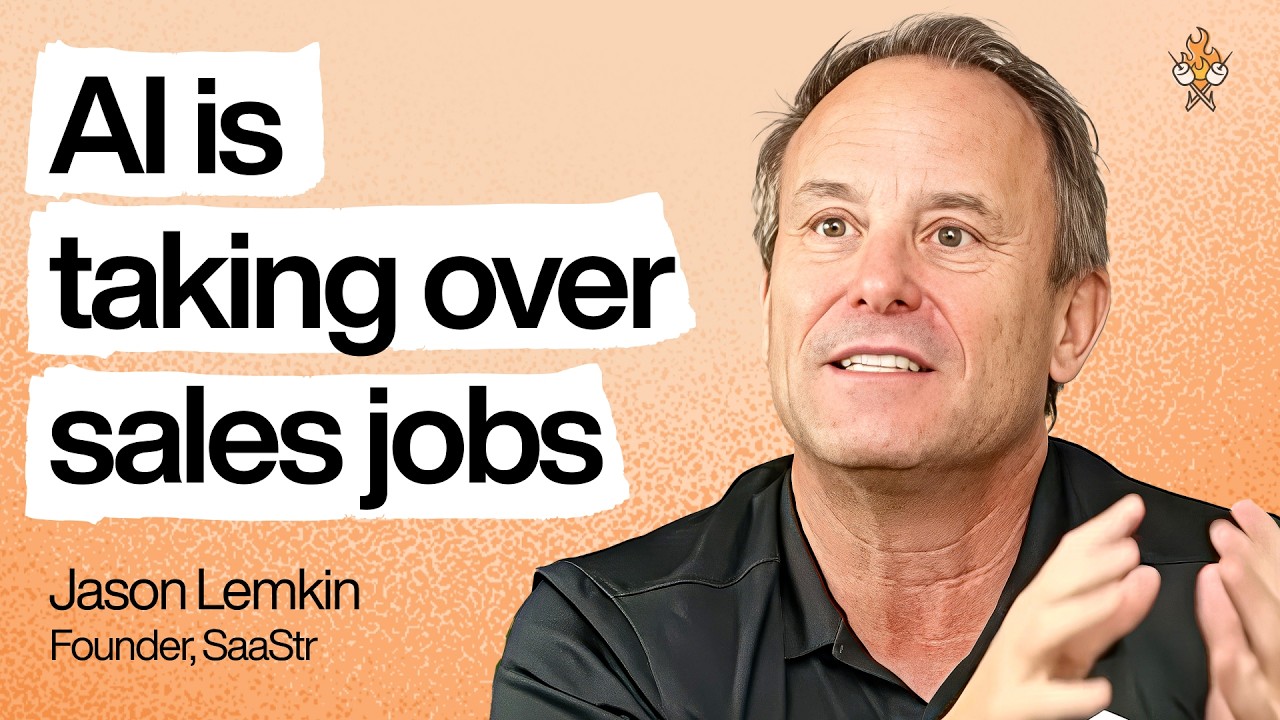
Jason Lemkin shares how SaaStr went from a 10-person sales team to 1.2 humans and
Jason Lemkin shares how SaaStr went from a 10-person sales team to 1.2 humans and 20 AI agents with the same revenue output. He covers which sales roles will go extinct, how to tra…
Why This Episode Matters
The Transformation
10-person GTM team → 1.2 humans + 20 AI agents. Same revenue. No layoffs — the humans quit.
The Extinction Clock
Email-based SDRs and inbound BDRs will be "mostly extinct" within 12 months. AEs have more time.
The Agent Playbook
How to pick vendors, train agents in 30 days, and why you should never build it yourself.
The Chief AI Officer
Why you need a nerdy internal person spending 10-15 hrs/week orchestrating agents.
The Market Split
Hyper-growth AI companies can't hire fast enough. Traditional SaaS is decelerating. Both need AI GTM.
The $250K SDR
The future isn't fewer salespeople — it's salespeople managing 10 agents instead of 10 people.
The Great Transformation
SaaStr runs an 8-figure-revenue events and media business. Before 2025, it had a traditional go-to-market team.
The catalyst: Two sales reps quit on-site at the 10,000-person SaaStr Annual event.
"We're done with hiring humans in sales. We're done. We are going to push the limits with agents."
Jason had already seen a "horizontal agent, not trained for sales" close a $70K sponsorship on its own. That was the proof point.
The SaaStr Office Today
The 1.2 Humans
- 1 full-time AE doing what 5-6 AEs used to do
- Amelia (Chief AI Officer) — 20% of her time managing and orchestrating the agents
- That's it. 1.2 humans.
The 20 Agents
- Reply — Replit-based agent
- Quali — Qualified (inbound)
- Arty — Artisan (outbound)
- Agent Force — Salesforce (reactivation)
- Deli — Digital Jason (support + general)
- Plus Momentum/Attention for RevOps
The net result: Productivity is about the same as 10 humans. Not better, not worse — but far more efficient, and it scales because software scales.
But Jason Would Still Hire Great Humans
"If I had two more great humans that wanted to join, don't get me wrong, I would hire them tomorrow."
The key distinction: AI is replacing the midpack and below, not the best.
What AI Replaces
- The rep who after 3 months doesn't know what the product does
- The SDR who sends generic emails with no research
- The qualifier who makes customers wait 2 days for a callback
- The rep who hadn't done anything in 30 days (he quit the day RevOps AI was turned on)
What AI Can't Replace (Yet)
- Enterprise reps who knock on doors in person
- The top 1% who spend 2 hours researching a single email
- In-person field sales
- High-dollar whiteboard sessions with 50 named accounts
OpenAI leadership told Jason they "just can't hire enough enterprise reps." The best humans remain in massive demand.
The B2B Market Has Split in Two
The market used to be mostly the same. Companies grew at similar rates, similar ACVs. Now it's wildly bifurcated.
"Everyone in the market at once. This is something that people don't understand."
Traditional SaaS: 3-5% of prospects in market per year. AI products: 50%+ in market right now. Everyone from law firms to video companies.
Both extremes have the same incentive: push AI for GTM in 2026.
Plays Work. Playbooks Don't.
Jason draws a sharp line between plays (individual tactics) and playbooks (the system that ties them together).
Plays Still Work
- Outbound still works
- Webinars still work
- Podcasts still work
- Events still work
- In-person closes at a higher rate
Playbooks Are Broken
- The 2021 GTM playbook has no ROI
- Growth has decelerated so much that nothing seems to work
- But the plays do work — they just have less ROI than before
- Old books are too backwards-looking
"It's just the playbooks are broken because at for folks that aren't in the age of AI, growth has decelerated so much that nothing seems to work."
His advice on GTM books: read them, grab 2-3 plays, but don't adopt the playbook wholesale. He's waiting for the next generation of GTM books written for the AI age.
The Sales Extinction Timeline
Jason gives specific predictions for which sales roles survive and which don't.
"The classic SDR junior kid that is hired out of college to send emails... We don't need them."
"Folks that qualify leads coming in, the contact me that we see, we have no need for them today. They should be extinct next year."
AEs: ~70% safe by end of next year, declining to 40-50% over time. Field sales: unknown — "no idea how AI is going to do in-person sales."
The Agent Deployment Journey
SaaStr didn't deploy 20 agents overnight. Each step built on the last, and each got easier.
Step 1 — Deli (Digital Jason): Started as a clone bot. People used it for support. Then it closed a $70K sponsorship on its own.
Step 2 — Artisan (Outbound): Sent ~60,000 emails. High response rates.
Step 3 — Qualified (Inbound): Someone at 11pm on a Saturday night wanted to sponsor — the agent closed it.
Step 4 — Agent Force: Reactivated leads humans ignored. Got a 70% response rate.
Why These Vendors Won: They Helped the Most
Jason's biggest vendor selection insight has nothing to do with feature matrices.
Vendor A
Argued with SaaStr. Demanded $100K upfront before any help. Not selected.
Vendor B
"Scared of SaaStr." Didn't want bad PR if it failed. Said "we don't want to be your first." Not selected.
Artisan
A YC startup. Offered to help the most. Did the work alongside SaaStr. Selected — and it worked.
The lesson: These agents all run on similar underlying tech. The difference is whether the vendor will actually help you succeed. Before you write a check, get on the phone with the forward deployed engineer and see if they'll really do the deployment work with you.
The best vendors today turn away business they don't think they can help succeed — which is a fascinating signal of quality.
How to Train an Agent in 30 Days
The biggest mistake of 2024: vendors said "just turn the product on" and it would magically work. It doesn't.
Jason describes the actual process:
- Upload your website, wiki, training docs, best emails
- Answer questions the agent asks (it's just Q&A, not scary)
- Correct mistakes every day for 30 days, 1-2 hours each
- By day 30, it's "pretty good"
Cheat code: After training 3 agents, they distilled everything into one prompt. Gave that prompt to Agent Force — it was "pretty good" in a day.
Train on Your Best Person, Not a Generic Template
The single most important thing Jason learned about making AI emails good:
"Take your best person on your sales team, the best marketer you have, take their email copy and use that as a template for your AI."
What Most People Do Wrong
- Use a generic untrained agent
- Give it to junior SDRs and expect magic
- Never upload any real training data
- A $10B+ public company called SaaStr for help — none of their 20 people on the call had done it themselves
What Actually Works
- Upload your best person's best emails
- Let the agent create A/B variants from that baseline
- Connect it to data sources (Salesforce, website visitors)
- It personalizes based on real data
- The AI produces a "facsimile of your best person"
Does It Matter If People Know It's AI?
After sending hundreds of thousands of emails, SaaStr tested both approaches.
What They Tested
- Emails signed as "Digital Amelia" or "Digital Jason"
- Emails sent without any AI disclosure
- Both approaches across high and low volume campaigns
What They Found
- It doesn't matter. People don't care as long as the email adds value and they get an instant response.
- Founders sometimes reply: "Haha, I can tell this is AI but it's pretty good. Can I do a meeting?"
The real insight: Most human sales emails aren't great either. Jason recalls inheriting Adobe reps whose emails were "the worst emails I've ever read." The bar for AI to beat the midpack is lower than we think.
"People Person" Is Not Enough Anymore
"Being a people person is not enough anymore."
Jason describes the tell-tale sign of a mediocre salesperson:
"You ask them what they're really good at. 'I'm a people person, Lenny.' ... What are the toughest technical objections you have at your product? They don't know, but they're a people person."
His challenge: if your defense in sales is being a "people person," go spend hours on Lennybot or ChatGPT.
"AI can be people people, too." ChatGPT is already the "best therapist on planet Earth." If your only value is warmth without product knowledge, the ground is shifting beneath you.
If You Can Close on a Text Message, AI Can Close
"If you can close on a text message AI can close."
Jason's London story: he wanted to buy a $10,000 product. Emailed the rep with two questions. It took three days to get a reply. The rep introduced someone else who demanded a phone call. The deal almost died — over two simple questions.
The Human Failure
- 3 days to respond
- Passed to someone else (not enough commission)
- Required a phone call to answer 2 questions
- Customer was ready to buy
What AI Would Do
- Instant response, 24/7
- Answer the questions immediately
- Close the deal on the spot
- No commission-driven cherry-picking
Reactivated leads that humans ignored got a 70% response rate from Agent Force. Those were people dying to interact — humans just weren't willing to follow up.
The Chief AI Officer Is Critical
Amelia, SaaStr's Chief AI Officer, spends 10-15 hours/week managing 20 agents. It's exhausting — but it's the new essential role.
"Agents work all night and they work weekends and they work on Christmas."
This is not a good job for lazy people. The agents never sleep, and someone has to review outputs, segment the base, fix mistakes, and orchestrate across 20 different tools.
Where to find this person: Promote someone internal. A nerd who loves data, comes from marketing/product/RevOps. The odds they come from regular sales? "Approach zero."
Jason is skeptical of the "GTM engineer" job postings on LinkedIn. The role needs someone who knows the product cold and loves sitting in front of data — not an engineer title.
The Ideal Chief AI Officer
Don't Build It Yourself (Unless You're Vercel)
Jason is a top 1% Replit user. He's built 12 apps in 150 days. But none of the GTM agents were built internally.
"Don't build it yourself unless you're Vercel, unless you have a reason."
Why Not to Build
- Pace of innovation is so fast — your internal tool will be obsolete in months
- You're not Vercel with a full-time engineer who wants to build this
- Maintaining it is a full-time job
- Same logic as "you could build your own Notion, but don't"
What to Buy Instead
- These products are ~$50K-$100K/year
- That's cheaper than one human ($150K+ fully loaded)
- They come with forward deployed engineers
- They iterate their product faster than you can
- Even Clay starts at ~$100K/year
The exception: if you have an awesome GTM engineer who is "chomping at the bit" to build it internally, and you're a company like Vercel — go for it. For everyone else, buy.
Agent Fatigue Is Real
Here's something most people aren't talking about: even SaaStr — at 20 agents — might be at capacity.
"We can't — I don't know when we're going to do the 21st. We may be full."
Business process change remains the bottleneck for enterprise software adoption. It always has been. And now it's compounded by agent overload.
The Warning for Startups
- Close your deals in the next 12 months
- The window may close when buyers say: "That's the coolest agent I've ever seen. I'm exhausted from the last five."
- Agent fatigue will become a real headwind
The Orchestration Tax
- Amelia spends 10-15 hrs/week on agent management
- Multiple agents hitting the same base create conflicts
- Someone must segment which leads go to which agent
- No "master agent that manages agents" exists yet
The Forward Deployed Engineer
Jason sees this role as one of the biggest shifts in B2B sales. Inspired by Palantir, but adapted for every startup.
The FDE's #1 job: make the customer succeed on day one. Not answer questions. Not support 8 reps. Make the agent actually work when it goes live.
"I wish every Salesforce customer now could go live before they pay."
A real example: an AI leader closed a $3M deal where the FDE did everything — went on-site, deployed, tuned, QA'd. Sales only handled procurement.
The $250K SDR and the 10x Rep
Jason's vision isn't fewer salespeople — it's radically more productive ones.
"We should have $250,000 a year SDRs, but they'd be like at Vercel, they'd be managing 10 agents, not 10 people."
That's $250K instead of $80-90K — because they're worth it when managing 10 agents that each produce the output of a human.
And the net effect on jobs? AI leaders "can't hire enough reps." The winners are growing so fast that even with more efficiency, they need more humans than ever.
Advice for Sales Leaders: Do It Yourself
Jason's advice for VPs and leaders worried about becoming obsolete:
The Recipe
- Pick one problem — support, SDR, inbound qualification, whatever is most painful
- Pick a leading vendor — one that treats you well and will help you
- Do it yourself — train the agent, ingest the data, do the iterations
- Spend 50-60 hours plus vendor qualification time
- Get it live into production
"If you can go do this, you're hyper employable."
The first one will be brutal. The second will be easier. By the third, you'll distill it into one prompt. Then you become the person every startup wants to hire as their chief agentic GTM officer.
Don't wait for an agency. Don't wait for your team. Don't wait for it to be easy. The agencies don't know how to do this yet. You've got to do it yourself.
Advice for Junior Sales: Embrace It
For individual contributors who can't get $100K agent budgets:
Embrace Every Tool Your Org Deploys
- Is it annoying that the agent set up 4 calls when you only wanted 2? Embrace it. You'll be twice as productive.
- Whatever tools your organization is using, become the best person at working with that agent.
- The agents create more work, not less — but it's better work.
The cautionary tale: When SaaStr rolled out AI RevOps (Momentum/Attention), one rep quit that day. Every action is now automatically tracked in the CRM in real time. He hadn't done anything in 30 days — "the gig was up."
"I'm working the hardest I've ever worked. That's with all these agents... it's not less work, it's more work. The agents are so productive you have to keep up."
The Incognito Mode Test
Jason's most actionable advice for anyone skeptical about where to start:
The Exercise
- Open your browser in incognito mode
- Go to your own product/website with a fresh Gmail address
- Try everything: support, contact sales, sign up, buy something
- You will cry about how bad some of it is
- Pick the thing that makes you cry the most
- Go buy that agent and fix it
"Pick the thing that makes you cry the most over your mold wine and go buy that agent and fix it."
Most people are so lost in strategic planning that they've forgotten what the actual customer experience is like. How bad support is. How long sales takes to respond. Do this once a year — ideally once a quarter.
What's Changed and What Hasn't
Permanently Changed
- Support: 50-80% done by AI, train has left the station
- Email-based SDR: will be mostly extinct within 12 months
- Inbound BDR/qualification: similarly extinct
- RevOps tracking: everything a human does is now tracked instantly in CRM
- Buyer expectations: customers expect the agent to work during the pilot before they pay
Still the Same
- All the individual plays work (events, outbound, webinars, podcasts)
- Enterprise relationships still matter for big deals
- Field sales and door-knocking still work, maybe better than ever
- Showing up in person still closes at higher rates
- You still need leadership — VPs, CROs, the C-suite
- High-dollar whiteboard sales with 50 named accounts
The net-net: We're going to need more sales and go-to-market professionals than ever — because the winners are growing so quickly that even with AI efficiency, they need more humans. But those humans need different skills.
The Best Startup Is the One You're Already At
"It's not too late, Lenny... for most stuff, it's not too late. It's still so early."
Jason talked to three founders in one week who wanted to quit their companies:
Founder 1
Raised $20M from a top VC. Quit the next day to chase AI.
Founder 2
CEO of a $250M company. Just quit. No successor. Joining a hot AI startup.
Founder 3
Crossing $100M. Wanted to leave after 10 years for a robotics startup. Jason: "You have nine figures of equity."
Jason's counsel: if you have happy customers, don't quit. Take those 500 happy customers, build the AI product, and sell to them. That's better than finding them from scratch.
"Don't quit if you have happy customers. They'll buy more from you."
Pick a Lane for Next Year
Jason closes with a binary choice. No middle path.
Lane A: Go All In
- Work harder than ever with AI
- Build/deploy agents yourself
- Embrace every tool, every opportunity
- Be on the bleeding edge
- It's more work, but "the most exciting time of our lifetimes to be in software"
Lane B: Slow and Steady
- Join one of the ~800 unicorns from 2021 growing at 8-15%
- They still need people, just not as many
- Will never IPO, but they're stable
- No shame in this path
- "We're humans. We have families."
"Don't pretend that there's this middle path going to start because it don't exist in GTM. And I don't think it exists in product or engineering either."
Bonus: The Pluribus Insight
Jason connects the Apple TV show Pluribus (about a connected hive mind) to the future of AI GTM:
Right Now vs. The Future
Today: Get AI agents to be almost as good as humans, but working 24/7 at scale. That alone is a resource you don't have today.
Tomorrow (the Hive Mind): When all agents can share data across every tool, know everything that happens, talk to each other in real time — then humans are truly at risk in GTM.
There's already a hint of this: Salesforce has become the "hub" for all AI GTM agents — they all plug into it. So the CRM is becoming the shared database for the hive mind of agents.
Jason: "The only greater time is going to be next year." Every year will be better than the last for builders.
Core Quotes
"We're done with hiring humans in sales. We're done."
"AI is replacing the jobs people don't want to do today, and it is displacing the midpack and the mediocre."
"If you can go do this, you're hyper employable."
"Being a people person is not enough anymore."
"Agents work all night and they work weekends and they work on Christmas."
"Pick the thing that makes you cry the most over your mold wine and go buy that agent and fix it."
The Future of Sales Is Already Here
"This is the most exciting time of our lifetimes to be in software."
Jason Lemkin · SaaStr · Lenny's Podcast