Cultivating Awe & Emotional Connection
Dr. Dacher Keltner × Andrew Huberman
Emotion scientist Dr. Dacher Keltner explains the neuroscience of awe — how shifting perception from "small to vast" triggers measurable health benefits including reduced inflammat…
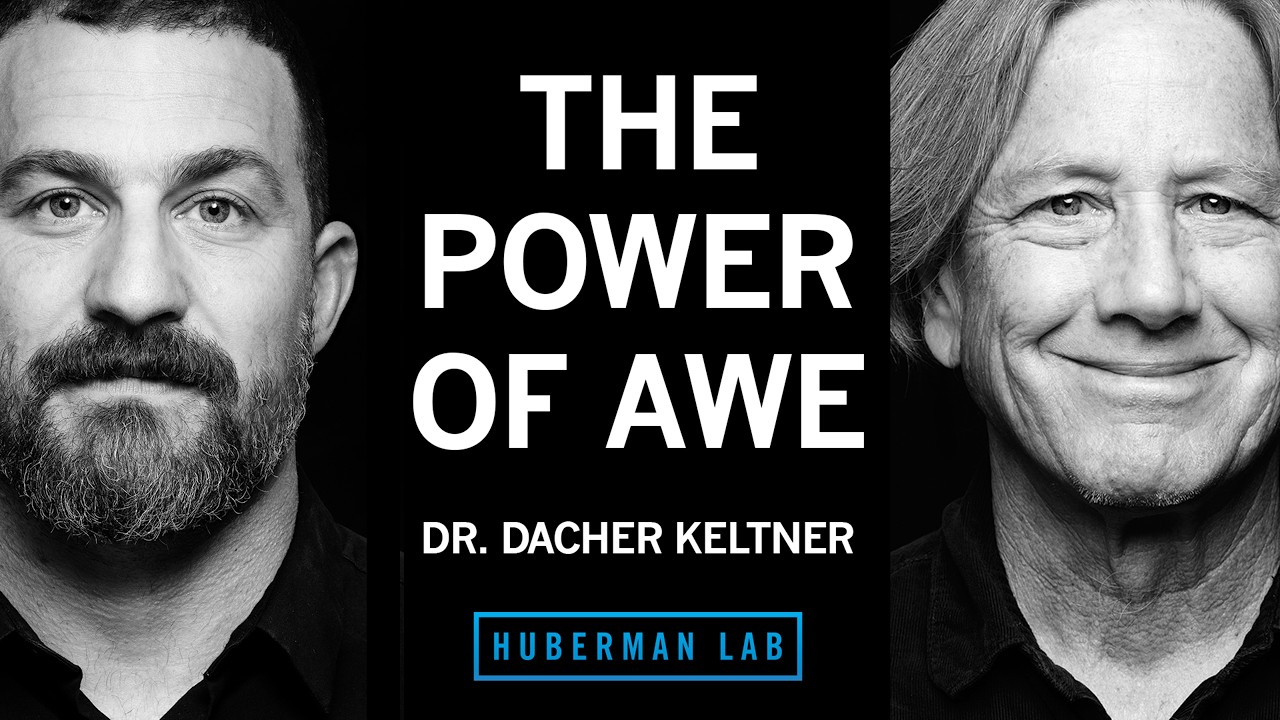
Why This Episode Matters
Emotion Science 2.0
From Ekman's 6 basic emotions to 20 distinct facial expressions — mapped across 144 cultures with AI
The Awe Walk
A simple weekly practice that reduces inflammation, eases pain, and improves brain health six years later
Music & Collectives
Why concerts bond us instantly — and what "collective effervescence" means for our fragmented era
Teasing & Embarrassment
How fraternity ribbing and blushing are actually signs of moral commitment to the group
Enemies of Awe
Self-focus, social media, and the "me drug" — what blocks our capacity for wonder
Awe by Design
From campfires to city architecture — practical ways to engineer more awe into daily life
Expanding the Vocabulary of Emotion
The Old Canon (Ekman, 1970s)
6 basic emotions studied via static photographs:
- Anger, Fear, Sadness
- Disgust, Surprise, Happiness
One hour to code one minute of facial muscle movements — painstakingly slow science.
The New Taxonomy (Keltner + Cowan)
AI-coded facial expressions across cultures reveal 20 distinct states:
- Laughter, love, compassion, awe
- Embarrassment, shame, pain
- And many more previously unnamed states
Key finding: Grad student Alan Cowan used AI with Google engineers to code 2 million videos from 144 cultures — found 75% overlap across cultures in how we express emotions like awe at fireworks or concentration on a test.
The Emotion Taxonomy
- Ekman's 6 emotions dominated the field for decades
- Keltner's estimate: 50 to 60% of facial expressions are hardwired through evolution
- The rest varies across cultures in "interesting ways"
- New tools: gaze patterns, face coloration, breath patterns, vagal tone, gut activation, voice
Keltner chose to study emotions based on "what's happening out in our lives" — not what's convenient in a lab.
What Is Awe? The "Small to Vast" Shift
The Core Mechanism
Keltner learned from Pixar's Pete Doctor: in animated films, the camera starts narrow — a certain kind of attention, sympathetic, fearful — and then suddenly reveals the vastness of something.
Huberman connects this to vision science: when our visual aperture widens (seeing a horizon), we become more parasympathetic. We relax.
The Evidence
Yosemite study: Hundreds of travelers asked "How do you feel about yourself right now?" answered: "I feel small and quiet, but part of something really large."
T-Rex skeleton study: People standing near a replica on the Berkeley campus became "expansive and collective."
Giant eucalyptus trees: Another natural laboratory for studying awe in the field.
Small → Expand → Vast
- Small: Narrow visual aperture, high alertness, fine-slicing time
- Vast: Wide aperture, parasympathetic activation, expanded time perception
- The shift itself is what triggers awe — not being in one state
Huberman's insight: "It's not about having a small aperture or a big aperture per se — it's the process of going from one aperture to the next."
A conductor told Keltner: "What's the secret? Why awe and music?" His answer: "Time. It's all about what it does to our sense of time."
The Awe Walk: A Simple Weekly Practice
The Protocol
- Go on your regular walk — once a week, half an hour
- Go somewhere you wouldn't ordinarily go — a place that may surprise you
- Slow down and deepen your breathing, sync it with your walking
- Go from small to vast — look at clouds, then the whole pattern of clouds; look at a tree, then the light on the trees, then patterns of light
- Listen to one laugh, then the whole symphony of laughter of kids
The Results
8-week study (75+ year olds): More kindness, more awe, less physical pain
6 years later: Better brain health (Virginia Sturm, UCSF study)
Long COVID: Just a minute of awe a day reduced long COVID symptoms
Broader effects: Reduced inflammation, elevated vagal tone — doctors are starting to think "I'm going to prescribe nature"
Spacetime Bridging: Huberman's Personal Meditation
Step 1
Step 2
Step 3
Step 4
Step 5
Key insight: Meditations focused purely inward made Huberman more focused inward. Running let him get outside his head. The breakthrough: it's the process of moving between apertures — not staying in one — that mirrors how life actually works.
The Neuroscience of Awe
Default Mode Network
Vagal Tone
Goosebumps
Jane Goodall's observation: Chimpanzees show awe-like behavior around vast nature — the "waterfall display." They sit quietly near rivers, get goosebumps, touch things like humans do. Goodall asked: "Why wouldn't they feel awe?"
Awe Through Time: Memory, Smell, and Connection
The Eucalyptus Memory
Keltner grew up around the UCLA campus where his mom got her PhD in the late 60s — eucalyptus trees everywhere. Years later, arriving at UC Santa Barbara as an undergrad, he smelled the eucalyptus:
"I smelled the eucalyptus and it was awe. It was just like — all of these experiences through the olfactory process."
Connecting Past, Present, Future
Huberman describes how hearing a song from age 15 opens up what he calls "the magic library" — one memory pulls out all the related ones, like a Harry Potter library where the surrounding books rearrange themselves.
The deeper layer: Feeling connected to someone in the present moment, then sensing your past/present/future is linked to their past/present/future. No drugs required — just openness.
Brain synchronization research: When we go to a concert or sporting event, our heart rates and brains synchronize — "the materialistic account of collective consciousness."
The 8 Wonders of Awe
From 2,600 stories gathered globally:
- Nature — trees, vistas, night sky
- Music — the "tonal language of emotion and identity"
- Moral Beauty — courage, kindness, justice in others
- Collectives — sports, concerts, protests
- Spirituality — meditation, prayer, ritual
- Big Ideas — epiphanies, intellectual breakthroughs
- Visual Art — museums, architecture
- Life & Death — birth, dying, transcendence
No one in 2,600 stories ever said being on Meta, Facebook, or Instagram gave them awe.
Music: The Fastest Path to Collective Consciousness
Brain Synchronization
- A nine-month-old listening to music is syncing up to the sounds and rhythms of their culture's music
- At concerts and sporting events, heart rates and brains synchronize
- This is "the materialistic account of collective consciousness — we're all sharing brain patterns and awareness"
Susan Langer, a philosopher, called music "this tonal language of emotion and identity."
Huberman's Punk Rock Epiphany
The show that changed everything: Rancid playing with Sick of It All, somewhere between 1993 and 1994, a little club in Santa Barbara.
"I feel very much a part of this. I love the music. I know every lyric — and I'm a little bit frightened and I love it."
Collective effervescence (Durkheim): Physical dancing, chanting, sporting events together — "syncing up with each other, feeling like we're part of this vast group."
What Killed Collective Music?
The Grateful Dead Story
On Tim Armstrong's recommendation, Huberman started listening to the Grateful Dead. Armstrong's reasoning: "They're punk rockers... they played a different show every night." Every show was unique — that was the collective magic.
Then someone asked: "What killed the collective of music?"
The answer: Cocaine.
"Cuz cocaine's all about me. It's the me drug."
The Laurel Canyon Parallel
Keltner grew up in Laurel Canyon (1968-70) during peak creativity — Joni Mitchell, the Birds, Beach Boys, Graham Nash. After his brother passed away, he read about what changed the scene:
The historians said the same thing — cocaine shifted everything from communal music-making to self-focused competition. The whole spirit changed.
Huberman's neuroscience gloss: Cocaine means dopamine and adrenaline. When those are elevated, every idea that's mine becomes the only thing that matters. Very different than cannabis, psychedelics, or the sober experience of just being with the music.
Joe Strummer: A Case Study in Moral Beauty
Why Strummer Matters to Huberman
- Lyrics that transcend language — like Bob Dylan, you're not sure what the song's about but it makes sense beyond the literal words
- Breath and intonation — "his intonation is like unparalleled"
- Total authenticity — Rick Rubin explained: "Everything he said, he brought his whole life experience into those statements"
Rick Rubin's superpower: "Rick knows what a true feeling feels like. And he knows what a false feeling feels like and he's only interested in truths. Period."
Strummer's Campfires
After the Clash ended, Strummer became famous for holding campfires — in Manhattan, by the river, with whoever would come.
- Kids, adults, famous friends and strangers
- Staying out till 2 or 3 AM, playing music, singing, drumming
- Not for recording or distribution — just for the experience
Keltner adds: "There's this new science of campfires — they're several hundred thousand years old." In small-scale societies, people gather around campfires to tell stories of how they're all connected.
The Enemies of Awe
Keltner quotes Ralph Waldo Emerson on awe: "Standing on the bare ground, my head bathed by blithe air and uplifted into infinite space... all mean egotism vanishes."
The enemies:
- Self-focus & narcissism — a quarter of all photos we take are of ourselves; half include the self
- Striving & money — worrying about status or bank accounts "counterveils awe"
- Online life — algorithmically designed to provoke hate, not demonstrate "all the wonderful things about human beings"
- Cocaine — "the me drug" — musicians traced the death of collective music to cocaine's self-focus
Social Media: The Antithesis of Awe
Social Media
- Small — tiny screen, tiny aperture
- Sped up — rapid-fire content
- Fragmented — disconnected bits
- Micro-focused — individual posts, reactions
- Forgettable — Huberman's test: "Do I remember anything specific from yesterday's scrolling? I don't think I do."
Awe
- Vast — panoramic, expansive
- Slows down — time feels different
- Integrates — connects past/present/future
- Systemic — about the whole, not the parts
- Unforgettable — "We could spend 15 hours talking about first concert, first love, first breakup"
Huberman's warning: "The only thing that resembles [forgetting yesterday's social media] is drugs of abuse." — a compelling, time-consuming experience that leaves nothing memorable behind.
Embarrassment: A Signal of Moral Commitment
The Discovery
Keltner was studying the startle response in Ekman's lab. After being startled, people got embarrassed — blush, avert gaze, hide face. Ekman told him: "That's a motor pattern of emotion. You should go study it."
Darwin had written about it: a person's embarrassment is a sign of their commitment to the collective.
Research finding: When you see people get embarrassed, you like them more, trust them more, give resources to them, and think they're a good group member.
The Brain Connection
Orbital frontal patients: People with damage to the orbital frontal cortex (from falls, motorcycle accidents) don't show embarrassment where they should — and others perceive them as "creepy" or not playing by the rules.
Darwin's insight: The blush is "a sign of your healthy character, your moral virtue almost." In nonhuman species, facial reddening is associated with physical robustness; in humans, it signals moral robustness.
The Science of Teasing
The Fraternity Study: Groups of four fraternity guys given initials to make up nicknames — then teased each other.
Results:
- The more they got embarrassed, the better they liked each other
- Better teasers — more playful, funny, aware of group norms but not humiliating — were more popular
- The teasing surfaced group norms: "What do we as a collective really care about?"
Jocko Willink's Rule: Guys tease each other relentlessly face to face — but never behind someone's back. And they'll defend the same person against outside criticism.
The Loneliness Epidemic: A Crisis in Numbers
Picnics
Movies
Meals Alone
Church attendance has plummeted — used to be 90%, now 55% of Americans attend. Shared music, listening to music together, walking together — all declining.
Community = longevity: A meta-analysis of 350,000 participants found social community confers roughly 10 years of life expectancy — more than any single exercise.
The Loneliness Crisis
Signs of renewal:
- Game nights coming back among 25-30 year olds
- Cooperative living — interest in living together
- Cooking together more
- Farmers markets: 9,000 and growing — people go for community as much as kale
- Yoga: One out of eight Americans now practices
- Festivals reappearing, dance groups returning
"Value-wise, they care more about community than my generation. I was the great explosion of individualism."
Sports as Awe: The Pittsburgh Steelers as Religion
The Sociology
A sociology paper argued that being a fan of the Pittsburgh Steelers is like being in a religion:
- Rituals (towels, songs)
- Identity ("Steeler Nation")
- "Godlike experiences on the field"
- Spiritual moments: "freezing days they'll take off their clothes and cheer and cry together"
- Intergenerational stories: an old fan telling a young one, "I remember when we lost in 1983, and we'll recover"
Steve Kerr's Perspective
Keltner spoke with Steve Kerr while writing his book on awe.
The experience of coaching the Warriors during their amazing period and looking up into the stands to see 10,000 people dancing because of the team's play.
Kerr embodies the connection: meditator, wilderness experience, and early trauma (losing his father) — all orienting him toward what really matters.
Psychedelics and Awe
Keltner's Path
Tried psychedelics in his late teens (17-19). "I was a very anxious obsessive kid and I think they opened up my mind in this perspective way we've been talking about."
He was reading Castaneda, "the doors of perception" — psychedelics embedded in a culture of trying to find mysticism.
Research: Molly Crockett at Princeton found that going to a festival with psychedelics makes you kinder a year later — through awe.
Huberman's Path
The opposite experience — terrifying early encounters, stopped, then later had immensely beneficial experiences in a therapeutic setting.
Both agree on microdosing: Robin Carhart-Harris's data show no evidence of benefit from microdosing on major depression — vs. two rounds of psilocybin with guide therapy.
The concern: Tens of millions now using psychedelics — not in the careful "cultural container of inquiry and knowledge and guidance" that Michael Pollan describes.
Awe Design: Engineering Wonder into Cities
The Opportunity
70% of the human population lives in cities. Most carbon emissions come from cities. These are places we can redesign.
The awe science gives a road map:
- A little nature — re-green parts of the city
- Some public art — visual beauty accessible to all
- Opportunity to recognize moral beauty — face-to-face interaction
- Collective activity — yoga in the town square, walking together
- Space for meditation and reflection
The Iron Works Model
Keltner's climbing gym example: people climb, but there's also an art exhibit each month of a local artist, and music playing. Multiple sources of awe layered naturally into one space.
The question for any space: Can it provide nature, art, moral beauty, collective activity, music, and reflection — the way temples and churches once did?
Japanese onsen: Built entire community experiences around hot springs — wash, bathe, eat together, spend time with kids. Wisdom built into the architecture.
The Awe Design Stack
Nature
Public Art
Moral Beauty
Collective Activity
Music
Reflection
Real examples: Iron Works climbing gym (monthly art exhibits + music), CrossFit gyms (barbecues + costumes), Japanese onsen (bathing + eating + community)
The shift: One out of eight Americans now does yoga. Farmers markets: 9,000 and growing. Both unthinkable 15 years ago.
The Wellness Community as Collective Awe
The Shift
It used to be meditation, breath work, Esalen — isolated pockets. Now people get together to sauna, to do breath work, to cold plunge. For thousands of years, humans did this. It's not new.
The Connection
People linked on social media who also do things in the real world — morning sunlight, gym, sauna. A community being built around shared practices, visible to each other.
CrossFit Example
Huberman remembers his ex-girlfriend's CrossFit gym: barbecues, cleaning the gym together, dressing up in costumes. "They had this awesome social community."
The deeper layer: People who want control over their state — "because otherwise the world will take control of it for you." It's not about supplements or cold plunges per se — it's about shared practice and agency.
Emotion, Motor Patterns, and Language: A Triad
Motor Patterns
Language
The Feeling
The fighting paradox: Sam Sheridan wrote in A Fighter's Heart that sparring is one of the most bonding experiences — "a primitive non-language state." Both vulnerable, obeying rules, transcending language. Like a mosh pit: there's something transcendent about crashing into each other.
The Aquarium Lesson: What We Wouldn't Do to Fish
What Huberman Does for His Fish
- Never isolate them from one another
- Give them enough places to hide (dominance hierarchy needs space)
- Keep them on a proper light cycle
- Feed them — but not overfed or underfed
- When the ecosystem is doing well: "I feel — it's a form of — it's brought me some awe at times"
What We Do to Ourselves
"I wouldn't isolate them, give them like little videos of other fish to look at. I know that wouldn't work. I know that they would die."
"I wouldn't do most of the things that we do to ourselves to my fish."
The insight: We evolved similar nervous systems and similar needs. The basic units of care and community are the same across species — we just play them out differently.
Campfires: The Ancient Technology of Connection
The Science
Keltner confirms: "There's this new science of campfires and they're several hundred thousand years old."
In small-scale societies, people gather at night around campfires and tell stories — stories of how they're all connected, watching out for what is dangerous in the dark. "A lot of stuff happens that's fundamental to our humanity around campfires."
Red light therapy bonus: Long wavelength light from fire goes through your body, is absorbed by water in mitochondria, and improves mitochondrial function — the same principle as expensive red light panels.
Huberman's Dream
Inspired by Strummer's campfires, Huberman floats the idea of touring — a bus, town to town, science and health discussions, but mostly just listening to people and doing campfires.
Keltner's version: "My dream was to take that bus and to go to all the basketball courts of the country."
The sauna connection: "Everybody sort of off-handedly notes like I love the conversations that happen in the sauna." Community emerges naturally when you share physical experience.
Do You Believe in Life After Death?
"I do. I do."
When Keltner's brother Ralph passed away from colon cancer, he had a profound transcendent experience that night. "I saw space in a different way. I saw something alive in him."
Afterward: the grief experience of his brother being around — "his voice, his hand was on my back."
He began thinking about quantum reality, dimensions beyond our three-dimensional view, electromagnetic waves around our minds syncing up with others, transcending the Newtonian world of the brain.
"I've moved from being a skeptical but open agnostic to like, yeah, there's something there that's beyond what we know."
Core Quotes
"I feel small and quiet, but part of something really large."
"Awe is one of the fastest pathways through... physical dancing together, chanting together, sporting events together."
"Words are tattered fragments. They barely touch the real thing."
"Rick knows what a true feeling feels like. And he knows what a false feeling feels like and he's only interested in truths. Period."
"A person's embarrassment is a sign of their commitment to the collective."
"All mean egotism vanishes."
"Cuz cocaine's all about me. It's the me drug."
"I wouldn't isolate them, give them like little videos of other fish to look at. I know that wouldn't work."
"I feel small and quiet, but part of something really large."
From the science of awe — a roadmap for reclaiming wonder in daily life.
Dr. Dacher Keltner · Huberman Lab