From Pet Treats to Explosives
Yaroslav Azhnyuk · The Fourth Law
Yaroslav Azhnyuk在旧金山创立了Pet Cube——"向宠物投射零食的摄像头"——然后,在俄罗斯入侵的前夜搭上飞往基辅的最后一班飞机(2022年2月23日),转型投身无人机自主系统、热成像摄像头和FPV攻击无人机的研发,服务于乌克兰武装力量。他与Noah Smith和Latent Space的Brandon共同梳理了无人机自主性五级体系、自主战…
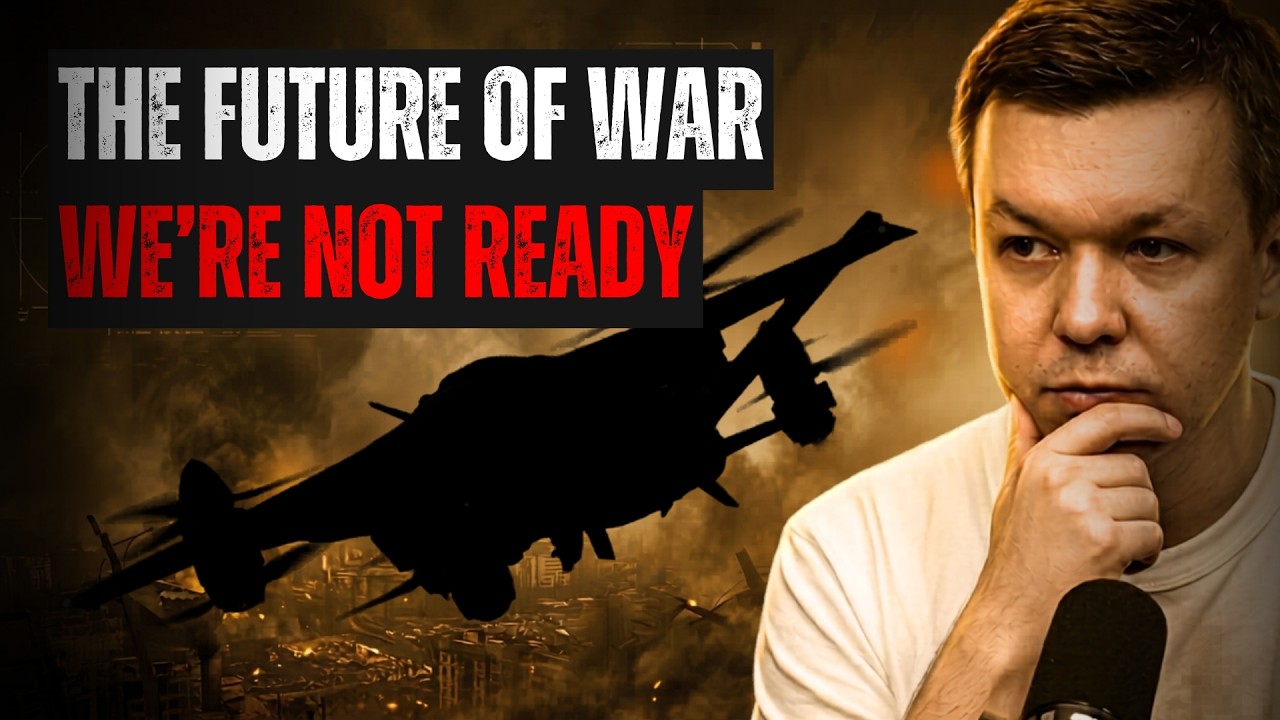
Why this episode matters
A founder's pivot
A consumer-tech CEO ends up at the heart of a defense industry — a clean window into how Silicon Valley craft transfers to a war economy.
Drones are the new artillery
80% of frontline casualties now come from FPV drones. Artillery was "the god of war." It just got dethroned.
The China overhang
Ukraine made 4M FPVs last year. China can make 4 billion. That number reshapes every strategic conversation.
A taxonomy of autonomy
Five levels of drone autonomy × eight dimensions of the autonomous battlefield — a coherent map of what's coming.
The moral frame
"You first deal with the wolf, then consult Greenpeace." A working theory of building weapons under existential threat.
What the West gets wrong
$3M lasers vs. $500 drones. Tanks vs. swarms. Why exquisite hardware loses to mass.
Feb 23, 2022 · The chapel
Yaroslav and his fiancée flew into Kyiv that evening — coming back from Lviv, where they had been scouting a wedding chapel.
The cab driver waved them off:
"You crazy — everyone's leaving Kyiv. Why do you come? Nothing's going to happen. Dude, chill."
8 hours later the bombs fell. They had landed on one of the last flights into Kyiv.
17-hour drive west. Diesel poured out of windshield-washer canisters because there were no proper jerry cans left at any gas station.
The pivot, in his own words
"At some point in my life, I went from making cameras that fling treats to pets to cameras that fling explosives to the occupiers."
Before 2022 — co-founder/CEO of Pet Cube in San Francisco (2014–2020), "one of the leading pet device companies in the world."
After — co-founder of The Fourth Law (on-drone autonomy) and Odd Systems (thermal cameras). The two companies are merging.
Day one — what do you actually do?
A short list of things Yaroslav says he and his network started before they ever touched weapons:
Advocacy
Reached out to US senators and congresspeople. Pushed Lend-Lease (passed May 2022).
Brave 1
Helped start what is now Ukraine's defense-tech cluster — described in the episode as a kind of Ukrainian DIU.
D3 fund
Helped start a defense-tech fund co-started by Eric Schmidt, former CEO of Google.
Then — weapons
By 2023 it was obvious the war would last and warfare itself was being redefined. He started The Fourth Law.
Why software-defined warfare is new
The pitch, in his framing:
"For the first time in history you have a platform that is software defined… you can push a software update and get all of your Roman legionnaire's a new helmet, you know — that has never been possible before."
Old
Hardware fixed at factory. Capability increases ≈ buy new units.
Now
A fleet of drones inherits new behaviors overnight via OTA.
Why he started
"Leverage the global techno-capitalist machine" to defend Ukraine and the free world.
The moral question
The hosts push: you build the tools, others use them. What about the future?
"…you first going to deal with a wolf that wants to eat you and then you're going to go consult Greenpeace. So, that's kind of situation that Ukraine is in."
"We're just passing the ammunition. We're not doing the actual job. The actual fighters and defenders and heroes are people in the armed forces."
作者概括: the moral argument here is not about weapons-in-the-abstract but about who chose the timeline — when the wolf is already in the room, the cost-benefit of refusing to act is itself a moral choice.
Five levels of drone autonomy
A taxonomy Yaroslav coined that "got picked up by the industry."
L1 — Terminal guidance. Pilot flies it close, locks target, AI takes over the last 500 m.
L2 — Bombing. Drop on target without a human in the loop on that decision.
L3 — Target detection + engagement decision. Find and decide who to hit.
L4 — Autonomous navigation. Get there without a human steering, even without GPS.
L5 — Autonomous takeoff and landing. The full envelope.
Inspired by SAE's self-driving levels — though, he notes, Waymo is still arguably "level 4" because remote operators step in.
What L1 alone does — pilot "Grom"'s numbers
One Ukrainian brigade using just first-level autonomy (terminal guidance).
Mission success rate
Effective kill zone
This is just L1. L2–L5 add more capability on top. The end-state estimate Yaroslav gives is 10× mission success rate and 10× utility per drone once full autonomy is on board.
Eight dimensions of the autonomous battlefield
Autonomy doesn't propagate along one axis. He counts eight.
1. Autonomy level (L1–L5)
2. Platform — quad, fixed-wing, ground, sea, undersea, missile
3. Domain — ground/air, ground/sea, sea/air, etc.
4. Higher-order: swarming, drone carriers, drone nests
5. Environment — day/night, summer/winter, terrain, target hiding
6. Command & control — coordinating tens of thousands of assets
7. Infrastructure — sim, data collection, security, deployment
8. Distribution — 100 units vs 100,000 units is two different ball games
The iPhone of warfare
The FPV drone
You don't carry a separate MP3 player and calculator — same logic for the drone vs. the artillery/missile/observer stack.
Autonomy on top
"You pick your smartphone, you say we are here, the bad guys are here, go and get them — and the drone goes up, flies, localizes itself on the map, finds the area, sees the bad guys, bombs them, returns, sits down."
Drones vs. artillery — three orders of magnitude
155 mm shell
FPV drone
+ full autonomy
"They used to say that artillery is the god of war because artillery used to cause like 80% of casualties… FPV drones are the god of war."
80% — the share of frontline casualties now caused by FPV drones
"Out of all the casualties on the front line between 70 and 80% are done by FPV drones."
Before
~80% of casualties were artillery.
Artillery = "god of war."
Now
70–80% are FPV drones.
The same throne, different king.
That doesn't mean artillery is gone. He's emphatic: "all of these systems are needed — maybe except cavalry, although Russians still use it." Modern warfare is a stack, not a swap.
Tanks vs. housewives — the Rheinmetall meme
The CEO of Rheinmetall — a major European defense manufacturer — publicly mocked Ukraine's drone industry, saying there was no real innovation and it was "made by housewives."
The Ukrainian response, via Alexei Babenko (founder of Vyriy Drone):
"The drones we manufacture in one day will be more than enough to destroy all the tanks Rheinmetall manufactures in a year."
One drone
~$500
One tank
~$5,000,000+
"Don't mess with those housewives." — "Drone wives." — Yaroslav & Brandon, mid-laugh
The optic-fiber surprise
Why fiber-optic drones (immune to jamming and the radio horizon) became the dominant FPV format — and then started getting 8× more expensive in months.
The reason isn't drone demand. It's the AI buildout:
"Because of all the data centers for AI. It's literally the same optic fiber that's being used there. When Ukrainians and Russians come to Chinese factories to buy the optic fiber, they're like: we're out. We sold it out to the Americans."
Optic fiber, early 2025
A few months later
Brandon's quip on hearing the number:
"Claude Code is stopping the Russian drone effort."
5–10 years from now — using weapons without AI will be immoral
A surprising claim from Yaroslav, in response to Brandon's worry about distribution-shift failures:
"I think 5 to 10 years from now it will be immoral to use weapons without AI — because weapons without AI will be more likely to cause collateral damage or unwanted damage. Same way it will be immoral to drive your own car manually on a public road, because it's more likely to cause unwanted damage."
Brandon's worry
Computer-vision systems fail out-of-distribution. Fog rolls in, drone hits the wrong thing.
Yaroslav's reframe
A mortar today lands ±0.5 km of where it was aimed. AI drones are vastly more precise than the baseline they replace.
The China overhang
The conversation pivots: forget Russia for a moment. What if the adversary is China?
The asymmetry is staggering. Ukraine — currently the world's most prolific drone power — produced 4 million FPVs last year.
China's manufacturing base could turn out 4 billion of the same drones.
"China can make them not drones with propellers but fixed-wing drones which go not 40 km far but maybe two or 300 km in land, slightly more expensive."
The container-ship scenario
Yaroslav walks through what a Chinese long-range drone campaign could look like — and why it would be hard to interdict:
- DJI-grade autonomy, no GPS required
- Fixed-wing range 200–300 km
- Packed onto shipping containers / freight ships / autonomous underwater vehicles
- Show up at "any coastline in the world — be it Taiwan or be it California"
"There are not enough hunter submarines. There are not enough anti-ship missiles… you wouldn't have enough assets to do preemptive strikes because there can be tens of thousands of places where these things are being manufactured."
Four layers the West lags on
When pushed on what the West specifically lacks, Yaroslav names four nested layers — top is hardest to fix, bottom is most fundamental.
Layer 4 Rare earth materials — not because they only exist in China, but because of "the refining capabilities."
Layer 3 Components — motors, fiber optics, thermal sensors, the magnets you need to make a good motor.
Layer 2 Mass manufacturing capacity — "tens of thousands of factories" is a different problem than "a few good companies."
Layer 1 Autonomy technology — the software stack he says only a handful of Western companies can do at all on small drones.
One year of drone-time
A jolting comparison Yaroslav draws between his frontline and the European defense establishment:
- The Ukraine ↔ Russia drone fight moved roughly a full year in twelve months — from 2025-grade tech to 2026-grade tech.
- Europe in the same year moved from winter of 2022 to spring of 2022.
- The US, by his estimate, made even less than a year of progress.
"The technological gap is getting wider and wider and wider."
Poland is buying the wrong things
Yaroslav looks at a country geographically next to Russia and shakes his head:
"They bought like 100 tanks and four submarines. It's like, dudes, you don't have like a thousand people who know how to operate an FPV. What the hell you're doing?"
His worry: Poland is "so proud of their winged hussars and their cavalry" while preparing for the wrong war. The host: "That happened in 1939."
Yaroslav: "I don't want that to happen again."
$3M laser vs. 6,000 drones
A scene from last year's LandEuro conference. He stops by the Raytheon RTX booth and asks about a new 10 kW laser air-defense product.
- "Can it take down an FPV drone?" — Yes, of course.
- "How long?" — Maybe 3 seconds.
- "What if the FPV tries to evade?" — We'll retarget. Another 3 seconds.
- "Can it handle a dozen?" — Yes.
- "How much?" — Something like $3 million.
"$3 million. So that is 6,000 FPV drones. I doubt this thing will be able to handle 6,000 FPV drones — or even 600 FPV drones — coming at it at the same time."
Counter-drone — what actually works
Not lasers. Not (mostly) shotguns held by a Rambo. The mix Yaroslav describes is much messier and lower-tech.
Fishnets and porcupines
"50 kilometers in from the front line all the roads are covered by fishnets." Tanks bristle with poles — to detonate the drone half a meter early.
Anti-FPV interceptor drones
A "harpoon-like" hand launcher; AI on board steers a small drone into the attacking drone.
Electronic warfare
Jamming the controller or video link — works if you know the frequency, and if the drone isn't fiber-optic or autonomous.
"Active armor" of drones
Speculative: an armored vehicle wrapped in protector drones that take off when something approaches.
"Things in practice in war are way way way more complex than they seem."
What about the rifleman?
Brandon wants to know: is the human soldier obsolete?
"If there is a guy in a dugout with some bullets and automatic weapon, the other guy cannot come and take that dugout."
Will last "for a while"
Drones do 80% of casualties. They do not yet hold ground.
"Crabization of warfare"
Quad robots, dog robots, humanoids — joked through. He doesn't disqualify humanoids on the battlefield "10 years into the future."
He references a Ukrainian punk-rock song titled "2030" — the war still going, AI and cyborgs everywhere, the simple infantry still cold in the dugouts doing their job.
The Budapest Memorandum lesson
Why he expects more countries to pursue nuclear weapons:
"Ukraine gave all of its nuclear weapons — the world's third-largest nuclear arsenal — because the US and Russia and others were very persuasive. They're like: yeah, just give it away, we guarantee you security. And they're like: oh, it's not guarantees, it's assurances. We use the word assurances. So therefore we didn't promise you much."
"Russia attacks and like no reaction. So the whole world in 2022 looks at it and it's like: oh okay, so maybe we should get nukes."
"My prediction next couple decades, a lot more countries will be working their own nukes."
Kyiv as Defense Valley
Asked for policy advice for America's defense establishment, Yaroslav reaches for Arthur C. Clarke (as he attributes it):
"The future is already here, just not evenly distributed yet."
"Just the same way as Silicon Valley is… sort of future location for all things tech. Kyiv and Ukraine is sort of the defense valley. It's the point where the future of defense has already arrived."
Specific exchange to learn from
- Hundreds of companies in narrow specialties
- Battlefield commanders, soldier through corps level
- The government's playing-field setup for defense startups
What's already moving
Procurement reform, "Drone Dominance" program. He says it's the right direction, just needs to scale.
Si vis pacem, para bellum
The last question of the episode — what should the audience walk away with?
"You want peace, be prepared to war.
Got to invest in defense and security."
The Latin original — si vis pacem, para bellum — would have been the obvious phrasing. He says it in English, plainer.
And the wedding? They got married. The social event is postponed until the war is over.
核心金句
"At some point in my life, I went from making cameras that fling treats to pets to cameras that fling explosives to the occupiers."
"…you first going to deal with a wolf that wants to eat you and then you're going to go consult Greenpeace."
"FPV drones are the god of war."
"The drones we manufacture in one day will be more than enough to destroy all the tanks Rheinmetall manufactures in a year."
"5 to 10 years from now it will be immoral to use weapons without AI."
"$3 million. So that is 6,000 FPV drones."
"Kyiv and Ukraine is sort of the defense valley."
"You want peace, be prepared to war."
Yaroslav Azhnyuk · Latent Space · with Noah Smith & Brandon