The Design Process Is Dead
Here's What's Replacing It
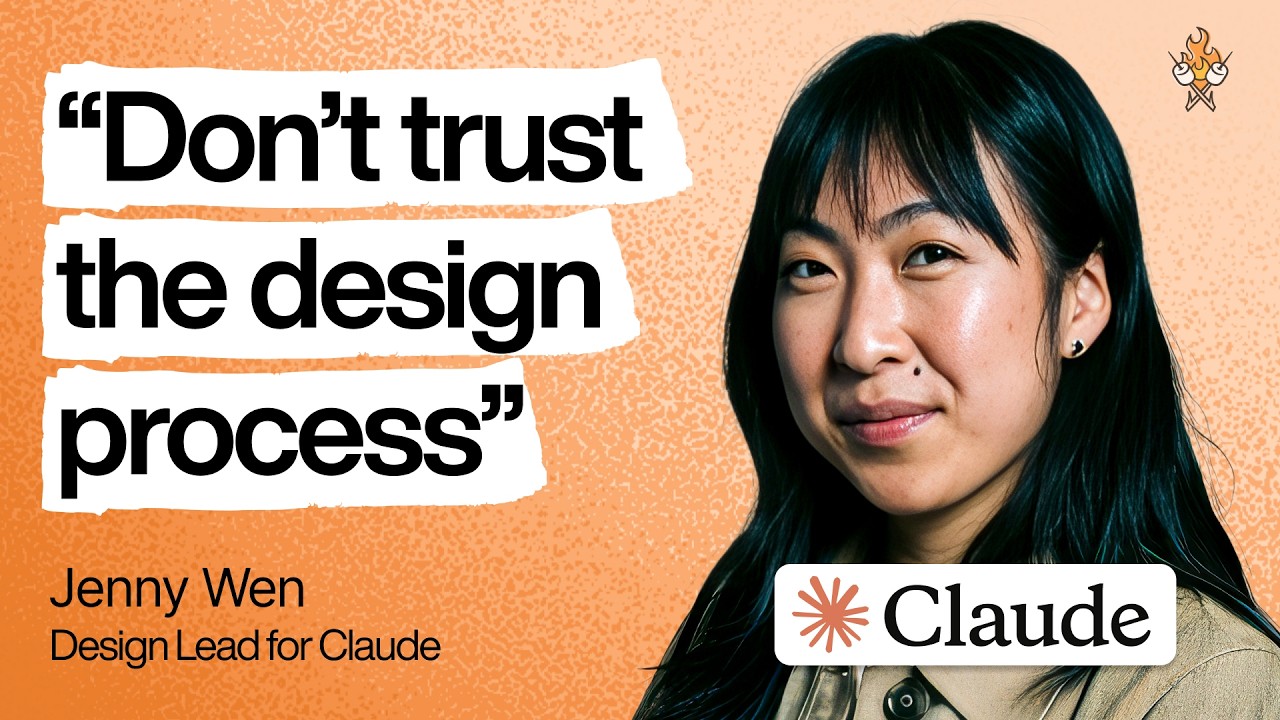
Jenny Wen, head of design for Claude at Anthropic (previously director of design at Figma), discusses how AI is fundamentally transforming the design profession. She argues the tra…
Why This Episode Matters
The Process Is Dead
The double-diamond design process that designers treated as gospel is no longer viable when engineers can spin up features with AI agents
Designer as Consultant
60-70% mocking has shrunk to 30-40% — the rest is pairing with engineers, polishing in code, and setting direction
Trust Through Speed
Ship early as a research preview, iterate on real feedback — that's how Anthropic builds products now
Hiring the New Designer
Three archetypes matter: the strong generalist, the deep specialist, and the overlooked craft new grad
IC > Manager (For Now)
Jenny left a director role at Figma to be an IC at Anthropic — and argues design managers need to do the same
The Legibility Framework
Designers should act like internal VCs — spotting illegible ideas with energy around them, then making them legible
The Design Process Was Treated as Gospel
"This design process that designers have been taught, we sort of treat it as gospel. That's basically dead."
Jenny gave a talk at a conference in Berlin in September called "Don't Trust the Design Process" where she argued:
What died
The diverge → converge → diverge → converge waterfall. Going off for weeks to do research, discovery, beautiful mocks — then handing off to engineering.
What killed it
Engineers can now spin off their "seven Claudes" and produce working features faster than designers can mock them. The forcing function is engineering speed, not a design manifesto.
Even that September talk already feels outdated to Jenny — especially after Opus and Claude Code adoption over the holiday break.
Two Modes of Design Work
Design work is becoming "really stratified" into two modes that coexist:
Mode 1: Execution & Support
- Engineers build scrappy versions of ideas
- Designer consults, gives feedback, polishes
- Working directly in code for last-mile quality
- Pointing engineers to the design system
Mode 2: Vision & Direction
- No longer 2-year or 5-year vision decks
- Now 3-6 month prototypes that point teams in the right direction
- Critical because "if we're all working towards something that has one greater cause, it's much more efficient"
The Time Allocation Shift
Jenny breaks down how her day has changed as a designer:
Before (a few years ago)
- 60-70% mocking and prototyping
- ~20% jamming with engineers
- ~10% coordination/meetings
Now (AI era)
- 30-40% mocking and prototyping
- 30-40% pairing directly with engineers
- A new slice: implementation (writing code)
Let Them Cook
"You're better off not blocking that, letting them cook."
It's not just designers struggling
Jenny notes this is universal: "It's not just designers who are feeling like oh yeah we have to keep up with engineers. I think even engineers are like how do we keep up with ourselves?"
The designer's new stance
Instead of gatekeeping, the designer becomes a guide — helping engineers connect ideas, create cohesive experiences, and not lose sight of the bigger picture as features fly out the door.
Lenny's summary: "How do we keep up with all our agents? There are seven agents who are constantly running."
A Day in the Life at Anthropic
Keeping Up
Reading internal Slack ("our Slack is a gold mine"), tracking model developments, internal prototypes with code names. Jenny calls this "the best AI news."
Jamming with Engineers
Whiteboarding, reviewing what they built, giving feedback. A lot of it is just conversations — not formal design reviews.
Writing Code
Polishing implementations, doing last-mile work. "An engineer and I have worked through something and they've implemented a first version of it and I just go in and polish it with them."
Jenny also uses Claude Code through VS Code, mobile, and Slack — someone says "this icon's off," you @ mention Claude, it fixes it, and you pick up the PR. "That's been really really fun."
Figma Is Still Alive (And That's Okay)
Where Figma still wins
- Exploring 8-10 different options at once — coding tools are "super linear," you invest in one direction
- Fine visual and interaction details — typography, micro-interactions
- Having a canvas to compare directions side by side
- "Having those in a canvas where you can just explore that specifically is still so so helpful"
The interesting twist
Lenny observes: engineers are moving away from IDEs to terminals and agents. Jenny still uses VS Code for CSS tweaks because it's faster than telling an agent to change a hex value.
Jenny's prediction: "Maybe IDEs now become useful for designers and PMs and engineers have moved on."
As a former Figmate (yes, that's what they call themselves), Jenny acknowledges bias — but says the gap Figma fills for exploration is still real.
Building Trust Through Speed
"Building trust through speed"
Jenny's philosophy on launching early:
- Ship it knowing "this is the worst it's ever going to be"
- Label it a research preview, caveat the flaws
- But commit to iterating publicly
- Respond to feedback, show you're fixing things
The one thing that degrades a brand: "if you release it early and then nothing ever happens."
Claude Co-work: Not Just 10 Days
The real timeline
Many internal prototypes over months. Different form factors for to-do lists, multiple choice questions, use case teaching. "It was not just 10 days and there was a lot of different people involved."
The 10-day sprint
What actually took 10 days: going from what they had internally to something ready to ship externally. The prototyping and exploration predated that by a long stretch.
What Jenny is excited about next
The Co-work homepage is evolving to feel more like a "shared to-do list between you and Claude" — things Claude is working on, things that need your attention. And the bigger question: "Is it stuck in the screen always or how does this sort of reach out to the different surfaces?"
How Jenny Describes Co-work
Lenny's description
Jenny's description
Jenny's favorite use case: giving Co-work a folder of local notes (one-on-ones, random thoughts, memos, interview notes) accumulated over years, and having it analyze patterns and create a design craft rubric from her own implicit thinking.
Where Human Brains Stay Valuable
"At the end of the day, someone has to decide what is actually going to get built and what actually matters. Someone still needs to be accountable for the decision."
The honest admission
Jenny thinks designers might be "holding on to that a little bit too much" — the idea that taste and judgment are uniquely human. AI's sense of taste will get better.
What remains human
The hardest parts of building software aren't building it — they're the disputes about what to include, the accountability for decisions, the social dynamics of teams.
Lenny's analogy: like radiology — AI might do the diagnosis, but a human is still needed to sign off because someone needs to be liable if they're wrong.
Chat Won't Die — But UIs Will Come Back
Why chat persists
Chat opened up "infinite ways to work with the model" — a new way to talk to computers that didn't exist before. It scales across all levels of intelligence (Kevin Weil's observation). WhatsApp/Telegram/SMS integrations were a huge unlock.
Why UIs return
Claude recently released interactive widgets — weather, stocks, questions — and "people still like to see UIs and touch them and click them." For specific tasks, direct UI is more efficient than typing.
Jenny's prediction: More UIs will be generated by models on-the-fly rather than hand-coded by designers. The interface becomes dynamic — chat for open-ended interaction, generated UI for specific actions.
From Director to IC — And Why That Matters
Jenny's path
- Director of Design at Figma (12-15 designers, multiple managers)
- Joined Anthropic as IC — deliberately
- Managed a team briefly, then back to full-time IC
- Self-described "reluctant manager"
Why IC right now
- "The design process has changed so much in this past year"
- Picked up hard skills she wouldn't have gained as a manager
- Needed to be close to the work to understand the new reality
- "If I had not worked in this environment, I don't know if I would have totally understood it"
The advice for managers: Jenny thinks design managers should take IC rotations — similar to how engineering orgs make new EMs pick up tasks for a few months before becoming full-time managers. "Design probably needs to do something similar."
What Was Rustiest Going Back to IC?
"Actually like doing crits, you know, and just getting criticized."
The vulnerability of presenting work and receiving critical feedback on a regular basis. As a manager, you give feedback. As an IC, you receive it — and that muscle atrophies.
On the future of management: Pure people management ("just somebody to sort of set you up, help you in your career, have one-on-ones") is fading. The future manager combines direction-setting with people management — someone who can "really engage with the team in terms of the work."
Her motto for team leadership: "whatever it takes" — whether the team needs direction, execution, or both.
Three Hiring Archetypes
Jenny sees three types of designers that are especially valuable right now:
1. Strong Generalist — "block shaped" in the T-shaped framework. 80th percentile good at multiple skills. Design + PM + engineering shaped.
2. Deep Specialist — T-shaped but the tip goes "down farther than most." Top 10% in one area. Could be 50% software engineer, or incredible at visual design.
3. Craft New Grad — The one "we're all overlooking." Early career, wise beyond years, eager, humble, blank slate. No baked-in processes to unlearn.
The Case for Craft New Grads
"Most companies are just hiring like senior talent... but given how much the roles are changing, having somebody who almost has like a blank slate and is just like a really quick learner... that's super valuable."
Why they're special
- No baked-in processes or rituals to unlearn
- "Sometimes they're actually unburdened" by lack of experience
- They feel "anything is possible"
- They just build stuff and share it
Jenny's advice to young designers
- Build actual things — not theoretical exercises
- Find a community (she mentions Socratica — a school movement about building and showcasing projects)
- Don't feel limited by how little experience you have
- "The best crack new grad folks I know are just people who just use the technology, build actual things"
Should Designers Learn to Code?
Jenny's nuanced take:
Yes, somewhat
"More and more of the designer vocabulary right now is implementing some stuff." The tools are making it more accessible.
But not from scratch
You don't need to learn React from zero. "Start to bring that into your toolkit" — the coding tools, not necessarily deep technical knowledge.
The abstraction keeps rising
As models get better, "we will continue to move up the abstraction layers and you won't have to actually know how each single line of code will work."
Is Claude a hirable designer?
Jenny's honest answer: "I don't think Claude is there yet in terms of a designer you would hire." It's good at a first pass and presenting many options, but "nothing there quite feels like special and hirable yet." Good news for designers — for now.
Low Leverage Is High Leverage
Jenny's "hot take": the low leverage stuff is often what has the most impact, because your team wouldn't expect you to spend time on it.
Dog-fooding the product
Senior leaders who obsessively test, repro bugs, share logs with engineers, nitpick details — creating deep product familiarity that cascades.
Fixing bugs yourself
Jenny has seen Mike Krieger (Anthropic CPO) put in PRs himself. "It's really nice because it's like, okay, cool, we're all on this team together and nothing is below this person."
The anniversary card
Going out of your way to make someone's anniversary card or vibe-code something special. An EA could do it, but a leader doing it shows genuine care.
Roasting = Psychological Safety
The roasting signal
When your team feels comfortable poking fun at you as a leader, it's a sign they don't fear you. Jenny's old team would imitate her saying "Okay, like what are next steps?" at crits.
The same comfort that lets you roast your friends — but applied to work. If it's there, the psychological safety is real.
The balance: high standards
Psychological safety alone isn't enough. You also need high standards. Jenny frames it as "being a tough parent" — always there for the team, but pushing for the best work.
"Once you have that psychological safety... applying the high standards actually becomes potentially easier because you can do it without fear."
Lenny connects this to Radical Candor: caring deeply + challenging directly. Jenny agrees — that's the balance.
The Legibility Framework
Jenny is obsessed with a 2×2 framework by Evan Tana (partner at SPC):
Founders can be legible or illegible.
Ideas can be legible or illegible.
The interesting zone: illegible ideas — ones on the frontier where people can't yet articulate the value.
Jenny applies this internally: scanning Slack prototypes, spotting energy around things she doesn't fully understand yet, then digging deeper.
"How can designers almost be more like VCs in this way internally — when we're looking at prototypes."
From Illegible Idea to Co-work
The illegible prototype: "Claude Studio"
An internal prototype — "this really kind of like dense powerful interface" built on an agentic harness. It showed knowledge, skills, and previews of Claude's outputs. Jenny looked at it and thought: "I don't know what's going on. I don't really get it."
But there was energy
Research folks and internal builders gravitated toward it. Jenny's legibility antenna went off: "I think there's like something here, but I just don't understand it yet."
What came from it
The skills framework (markdown files that instruct Claude on how to do something) emerged from that prototype. When Jenny started working on Co-work, she pulled out patterns: showing Claude's plan and to-dos, the files it was going through — elements that users found genuinely helpful.
Advice for Designers in an AI World
For new designers
- Build actual things — not theoretical exercises
- Use the technology, share with a community
- Check out movements like Socratica (building and showcasing projects)
- Don't feel limited by lack of experience — "they actually don't have expectations of themselves... they feel like anything is possible"
For senior designers
- Bring coding tools into your toolkit (even if you don't learn React)
- The abstraction layers keep rising
- Resilience and adaptability matter more than mastery of old processes
- Try new methods, try new tools — "be really willing to adapt"
Jenny's shout-out to the Anthropic Design team: "A team of folks that are really humble and they're not always loud on social but they're doing really great work... the team is so resilient." They span from deeply technical prototypers to high-craft production designers — and they're hiring.
Lightning Round Picks
Books
- The Power Broker by Robert Caro — "in this era when our attention spans are so short, this is actually worth reading end to end." A reminder that careers are long.
- Insomniac City by Bill Hayes — a memoir about Oliver Sacks' last days and love and mortality. "Very little to do with this podcast, but it's just a book that I really love."
Movie/TV
- A Sentimental Value (Norwegian film) — by the director of The Worst Person in the World. "The pacing, the writing, the relationship between the characters is just really subtle and beautiful."
- The Pit Season 2 — "everybody just likes to watch people who are really competent at their jobs do something."
Favorite Product
Retro — a community photo sharing app, no social media bloat. After 2 years: "I can look back at each year and see like, oh yeah, this week two years ago I was doing this."
Life Motto
"It is what it is." — "Sounds super defeatist, but I promise it's not." In a world of constant change, sometimes this is the levity you need to move forward.
核心金句
"This design process that designers have been taught, we sort of treat it as gospel. That's basically dead."
"You're better off not blocking that, letting them cook."
"Even engineers are like how do we keep up with ourselves?"
"We might be holding on to that a little bit too much" — on taste and judgment being uniquely human
"Someone still needs to be accountable for the decision."
"Building trust through speed" — ship early, iterate publicly, respond to feedback
"It is what it is."
Jenny Wen · Head of Design, Claude
@jenny_wen on X