The Theorem That Proves Science Can't Know the Universe
Professor JB Manchak proves that no amount of empirical data — even from every point
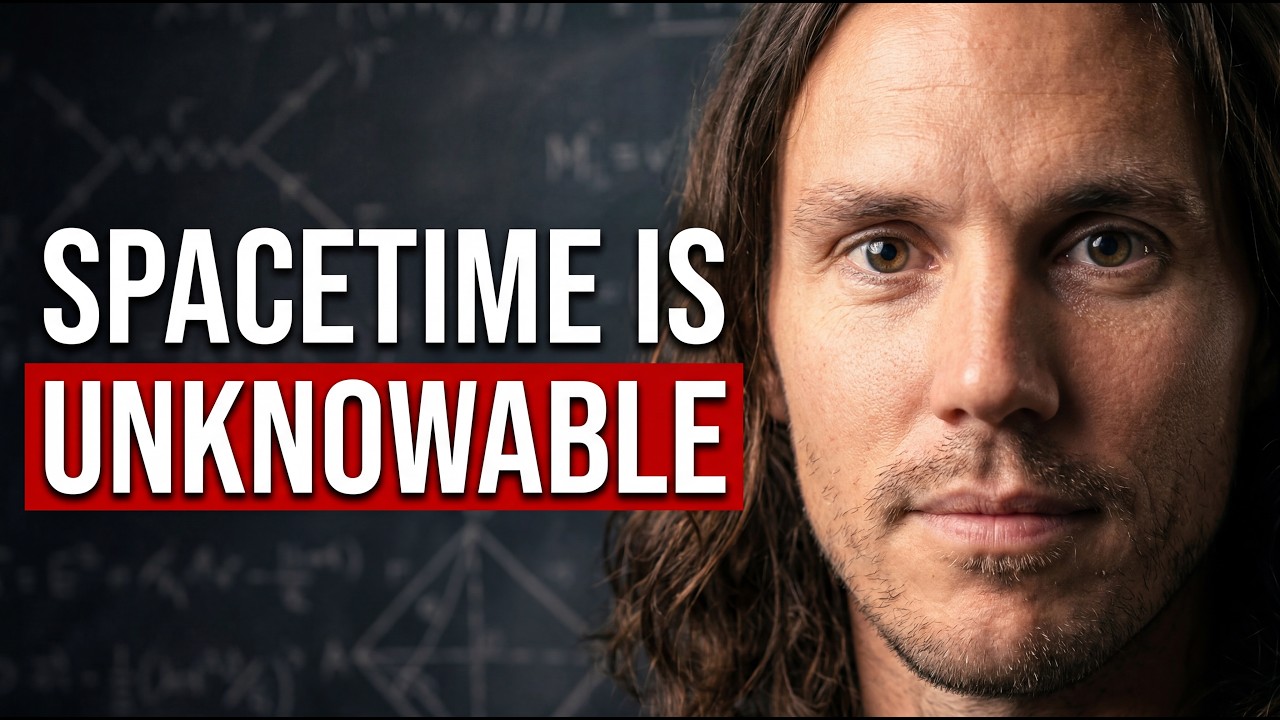
Professor JB Manchak proves that no amount of empirical data — even from every point in the universe — can determine its global structure. He introduces Heraclitus spacetimes (maxi…
Why This Episode Matters
Science Has Limits — Proven by Science
Manchak proves theorems showing that even with all possible data from every point in the universe, you still cannot determine its global structure.
GR Is Not One Thing
General relativity admits a vast zoo of models. Which ones are "physically reasonable"? Manchak argues we may never settle that question.
Heraclitus Spacetimes
A new class of spacetimes where every event is different from every other — and where local structure does determine global structure.
From Physics to Zen Buddhism
Manchak draws a parallel between cosmic underdetermination and the Buddhist teaching of non-self — both involve limits of grasping.
Time Travel & Malament-Hogarth Machines
GR permits closed timelike curves. Malament-Hogarth spacetimes can in principle solve the halting problem — but blue shift gets in the way.
The Philosophy of Physics as Theorem-Proving
Manchak's style: formalize a philosophical question, then prove or disprove it. No flowery prose — the theorem is the philosophy.
What Is General Relativity, Really?
Manchak insists GR is not one thing — it's a collection of models, and which ones count is up for debate.
The standard collection: all 4D manifolds with a Lorentzian metric. Every such manifold satisfies Einstein's equation in a minimal sense.
Pairing down: Energy conditions, causal conditions (no time travel? stable causality?), hole-freeness — each choice gives a different "GR."
"Everyone agrees that the real GR, whatever it is, is some subclass of models. And so, the question is, well, which one?"
The Pluralistic View of GR
"I have a pluralistic notion of what this thing is."
Determinism depends on which GR
Is GR deterministic? That depends entirely on your background collection of models. Kick out the "pathological" ones and it is. Let them in and it isn't.
"You can say GR is deterministic if you kick out all the models that show that it's indeterministic."
Cosmic censorship: same game
Penrose's cosmic censorship hypothesis says all physically reasonable spacetimes are globally hyperbolic. But if your background collection is small enough, it's trivially true. If it's large enough, it's false.
"Everything turns on how big or small is your collection going to be."
Norton's Dome parallel: Norton showed Newtonian mechanics is indeterministic if you don't assume Lipschitz continuity. Manchak notes a key difference: in GR, indeterminism arises within the standard collection — no need to go outside it.
Cauchy Surfaces, Horizons & Determinism
Cauchy Surface
Global Hyperbolicity
Cauchy Horizon
Cosmic Censorship (Wald's formulation): "All physically reasonable spacetimes are globally hyperbolic." If true, you can always evolve data to a maximal spacetime with no Cauchy horizon. If false — the universe has built-in indeterminism.
Black holes were once considered "pathological" too — including by Einstein himself. A priori dismissal of exotic solutions has a poor track record.
Time Travel in General Relativity
What GR actually allows
Models with closed timelike curves: a particle's worldline wraps back on itself, revisiting the same event. The matter returns to its original state — periodic, not paradoxical.
Godel presented Einstein with the Godel solution in 1949, which allows for time travel. Einstein's response: "We'll have to see if there are physical reasons to exclude such a model."
Decades later, still unresolved
Many theorems have been proven about excluding time travel models. Manchak's position: we don't know.
"I find it fascinating that even a position like that which is very non-committal and it's very modest somehow is seen as almost radical."
Malament-Hogarth Spacetimes
A spacetime where an observer at a finite point can see the entire infinite future of another observer in their past light cone.
Solving the halting problem: Send a computer into the infinite-future region. It runs a program. If it halts, it sends a signal. You — at the MH point — receive the answer in finite time.
The blue shift problem: Signals bunch up as they approach the MH point. Wavelengths compress toward the blue end. Some argue this makes MH spacetimes unphysical.
Manchak's counterexample strategy: Build an MH spacetime that satisfies energy conditions, is stably causal, doesn't require infinite fuel — knocking down each objection one by one.
The Cut-and-Paste Construction
How it works
Take well-behaved spacetimes (e.g. Minkowski). Cut slits. Glue pieces together in exotic ways. You create wildly unusual topologies — but they are still valid models of GR.
The point: counterexamples
Penrose and Geroch emphasized these aren't meant as physical models of our universe. They serve as counterexamples to certain lines of reasoning.
Manchak's use: "I have a counter example to that line of reasoning because I've now exhibited a space-time which is Malament-Hogarth that doesn't have property X, Y, or Z."
The ball-in-your-court move: Each counterexample forces the critic to find a new reason to exclude MH spacetimes. The existing objections (blue shift, energy conditions, infinite fuel) have all been addressed — "the criticisms you have so far aren't quite enough."
The Unknowability Theorem
Manchak proved what Malament had conjectured in the 1970s — and then went far beyond it.
The setup: Give me a spacetime. Put an eyeball at every event — past, present, future. Collect all data from everywhere, everywhen.
The result: Manchak can construct a "nemesis" spacetime that reproduces all of that data but has a completely different global structure.
The extra level: Even if you constrain local properties (vacuum solutions, energy conditions), the nemesis still works. Local induction cannot pin down global structure.
What the Unknowability Theorem Shuts Down
Common objection: "Science uses induction, not deduction"
The theorem anticipated this. It doesn't just show deductive underdetermination. It lets you do any kind of local induction — preserve local laws, energy conditions, vacuum properties — and the unknowability still holds.
The only escape: global assumptions
To "wiggle out," you must assume certain global properties. But that's precisely what's at issue — we don't know the global structure. Assuming it to prove you can know it is circular.
"I love science and that's what I do every day... but science has its limits. And so what I'm trying to articulate is that one can use science to show that science has limits."
This is not the Matrix-style "maybe I'm a brain in a vat" underdetermination. Manchak starts from our best physical theories and follows their consequences. It's science showing its own limits, not philosophy imposing limits from outside.
De Sitter: Where the Trouble Begins
The de Sitter problem
In de Sitter spacetime, light cones have asymptotes — they don't open up like in Minkowski space. You see very little of the universe from any point.
Result: You cannot distinguish whether you're in de Sitter, or in "unrolled" de Sitter, or de Sitter with holes, or any number of other possibilities.
Why it matters
De Sitter is not some exotic construction. It's a well-behaved, globally hyperbolic, vacuum solution — the kind of spacetime that's relevant to our actual cosmology (our universe is approximately de Sitter in its late expansion).
Malament used it to introduce the cosmic underdetermination problem. Even "nice" spacetimes have this issue.
Manchak: "I think having the de Sitter in the background is really a really good thing to do" — it motivates the entire unknowability program by showing the problem isn't just about pathological edge cases.
Spacetime Maximality: Why Would Nature Stop?
The dogma: If a spacetime can be extended (made bigger), it should be. A non-maximal spacetime is "unphysical." This was originally justified by Penrose and Geroch with what Manchak calls Leibnizian metaphysics.
"Why would nature stop when nature could keep building? So she has to keep building."
Manchak's challenge
Once you kick out "pathological" models, the remaining collection may not support Geroch's theorem (every spacetime has a maximal extension). The theorem depends on which models you allow.
Pandora's box
Removing models changes the entire modal structure. Results proven for the standard collection may fail for subclasses. Examining the justifications reveals they are — in Manchak's word — "piffy."
Heraclitus Spacetimes
Named after the philosopher of flux: "You can't step into the same river twice."
Definition: A spacetime where any two distinct events differ in some invariant way — their curvature properties are never identical.
Not a special case: Manchak argues that generically, almost every GR spacetime is Heraclitus. The symmetric ones we study in textbooks are the exception — they're just easier to write down.
Not pathological: You can have globally hyperbolic Heraclitus spacetimes. No singularities. No curvature blowups. Just... radical asymmetry everywhere.
The Puzzle Piece Argument
"If I'm in a Heraclitus spacetime, there is only one way to put the pieces together."
Heraclitus universe
Cut spacetime into tiny puzzle pieces. Each piece has unique curvature. There's only one way to assemble them — like a jigsaw where every edge is unique.
Local structure determines global structure.
Minkowski universe
Cut Minkowski spacetime into a million pieces. Every piece looks the same. You could reassemble them as flat Minkowski, or rolled up (with time travel), or with a giant hole in the middle.
Local structure does NOT determine global structure.
This is Manchak and Barrett's work — in a sense, Manchak arguing against his own unknowability theorem, exploring its limits.
Symmetry vs. Structure: Earman's Hierarchy
From John Earman's World Enough and Space-Time: more structure → fewer symmetries → more meaningful questions of motion.
Leibnizian: Maximum symmetry. Can't even talk about acceleration. Every transformation is allowed.
Galilean: Enough structure for F=ma. Acceleration makes sense, velocity doesn't.
Newtonian: Absolute space. Now you can ask "am I moving?"
Aristotelian: Even has a center of the universe. Can't even translate.
Heraclitus blows it up: Asymmetry maxes out, but structure can keep increasing. The inverse relationship between symmetry and structure — decades of philosophical dogma — breaks down.
Heraclitus and FLRW: Is the Big Bang Still Safe?
The worry: FLRW models (Big Bang cosmology) have enormous symmetries — homogeneity and isotropy. If the real universe is Heraclitus, does that undermine the Big Bang?
Manchak's answer: No tension
It's a matter of scale. Heraclitus means every point has slightly different curvature when you zoom in. FLRW works at grand cosmological scales — the tiny curvature differences wash out.
"Our universe is not completely symmetric... It's not completely homogeneous or isotropic."
The real point
FLRW is an approximation of a Heraclitus spacetime in the background. As long as you understand it's an approximation and don't bang your fist on the table saying it's the true representation — there's no problem.
The Malament Style: Philosophy as Proof
Malament's theorem on causal structure
Hawking et al. showed causal structure determines topology for "nice" spacetimes. Malament (1977) asked: how weak can the causal structure be and still determine the shape of the universe? His answer became the foundation for the causal set approach to quantum gravity.
Rotation in GR
What does it mean for object X to rotate around object Y in GR? Multiple criteria exist. Malament formalized each one and proved they come apart — an object can be rotating according to criterion A but not B. Rotation in GR is deeply subtle.
"The real genius of someone like David would be to find a way to ask a philosophical question in a very rigorous type way and then prove a theorem that essentially gives you an answer for that philosophical question."
Manchak's Own Style: Terse by Design
Two-page papers
Manchak doesn't put a word in a paper unless it's necessary. His papers can be two or three pages — unusual even in physics, unprecedented in philosophy.
"For me, my theorem that is my philosophy and so I let the results speak for themselves."
Counterexample as weapon
Rather than long arguments about whether MH spacetimes are physical, Manchak builds a specific model that dodges every known objection. Then: "If there's something else you're thinking of that makes it unphysical, then speak up."
The slow thinker's advantage
"I really am very slow. I've learned this stuff over the course of 20 years now... Things don't come very quickly to me."
But he's relentless — "tenaciously come back to the same idea again and again and again." The recent paper with the Budapest logic group solved a problem posed by Geroch 50 years ago.
The Hole Argument & Spacetime Ontology
Substantivalism vs. Relationism
Substantivalists (Newton's tradition): spacetime points exist independently of matter.
Relationalists (Leibniz's tradition): only spatiotemporal relations between events are real.
The hole argument (different from "holes" in spacetimes) has generated decades of literature on this question.
Manchak's position: no dog in this fight
Following Malament's lead, Manchak finds the distinction unclear. When you try to articulate what both positions really mean, you quickly arrive at: "What's the argument about?"
"I didn't see really any progress being made there... what I saw were some handwavy gestury type of stuff and that's just not my bag."
His bag: Making things precise. It took a long time for him to find something he could say "in a very precise way that has relevance to these issues."
The Fractal Time Machine Problem
The question
Take an extendable spacetime with no closed timelike curves (no time travel). Is it possible that every extension introduces time travel? In other words: can you find a spacetime where the only way to make it bigger is to allow time travel?
Manchak's idea
Take Minkowski spacetime, roll it up (introducing closed timelike curves), then remove a fractal — a Cantor set — of delicate holes that block the time-travel curves. Any extension must fill in part of the fractal, reopening a path for time travel.
The Budapest connection
Manchak shared this sketch with the logic group in Budapest. They made it rigorous. The paper was recently published — solving a problem Manchak had been thinking about for 10 years.
From Cosmic Underdetermination to the Self
Manchak teaches an intro philosophy of science class structured around two case studies of underdetermination:
Case 1: The Universe
Cosmic underdetermination — you can't pin down the global structure of spacetime from any data.
Case 2: The Self
Hume's empiricist insight — when you look inward, you find perceptions but never find you.
Hume: "I see love in me. I see hate in me. I see pleasure. I see pain... but I never see me."
Both the cosmos and the self resist being "pinned down" by empirical data. Manchak sees a structural parallel — not a direct connection, but the same shape of problem: data underdetermines the thing you're trying to know.
Zen Buddhism and Non-Self
Why Zen?
Manchak grew up Mormon. After getting tenure at UC Irvine, he found a zazen group in his neighborhood. Zen attracted him because it's skeptical of expressing truths through words and theories.
"It's the one that allows me to almost be a spiritual person without being a spiritual person."
Non-self ≠ grasping "no self"
A Zen master would say someone who declares "I figured it out — Buddhism is about non-self" has missed the point entirely.
"You're grasping too hard on this idea of non-self. Whenever you're grasping on anything, you're not doing the Zen thing."
The finger and the moon
Zen is skeptical of words and theories. The teachings are the finger pointing at the moon — they're supposed to catalyze a direct experience, not be grasped as doctrines. This mirrors how Manchak's theorems point to something beyond what the formalism can fully capture.
Science Showing Its Own Limits
"One can use science to show that science has limits."
What Manchak is NOT doing
The Descartes / Matrix / brain-in-a-vat style of underdetermination: "Maybe I'm being deceived by an evil demon." Fun to think about, but it doesn't come from our best scientific theories.
"That hallucination stuff, the matrix stuff... I don't lose sleep about that stuff."
What he IS doing
Taking science seriously. Diving into the details of GR. Following the consequences of our best physical theory to their logical end. And the answer is: no, science cannot tell us the global structure of our universe.
"Let's see what our best science says about what we can know... the answer is no."
Practical Zen: The Manchak Family Practice
Manchak's Zen practice is deeply embedded in daily life. Every night before bed, the whole family gathers — wife, daughter, the dog — on his daughter's bed for meditation.
A framework, not a doctrine
Manchak thinks of Zen as a kind of religion — it provides a framework, a structure for making sense of life. But it's characteristically minimal, free of the elaborate belief systems he left behind.
Simplicity everywhere
The same aesthetic runs through his math (two-page papers), his philosophy (theorem = philosophy), and his spiritual practice (sit, don't grasp). Radical simplicity as a way of life.
"I think of it very much as a kind of a religion for me... it provides a kind of framework and a structure and that's what I wanted and needed."
God Points and the Limits of Omniscience
What is a God Point?
An event in spacetime whose past light cone contains the entire universe — including the future. From a God point, you can see everything. This necessarily implies time travel (you're seeing your own future in your past).
Why it matters for unknowability
If a God point exists, Manchak's unknowability theorems don't apply — you literally have access to all information. So he introduces a minimal condition: restrict attention to spacetimes without God points.
The irony
Even the most generous possible observer — one with "eyeballs everywhere in the universe, everywhere, everywhen" — still can't determine global structure. You'd need omniscience beyond what physics permits.
Styles of Philosophy of Physics
The Malament School
Formalize philosophical questions. Prove theorems. Let results speak. Manchak's tradition.
The Practice School
Engage with how physicists actually work. David Wallace, Tim Maudlin — philosophize about the practice of physics.
The Armchair School
Start from your own system. Bring in physics here and there, but don't necessarily begin from the formalism.
Manchak's reflection: "When I was a youngster I wasn't aware of all of these ways... for me it was just like there's physics, there's philosophy, bringing them together — that's got to be like this one thing. But it's not one thing."
Sound familiar? GR is not one thing. Philosophy of physics is not one thing. Even Buddhism is not one thing.
The Symmetry Buddies
After years of writing papers alone, Manchak found collaborators who share his style: Thomas Barrett, Jim Weatherall, and Hans Halvorson. They co-author papers on symmetry and structure — all working in the Malament tradition.
Papers by text message
Every night, Manchak falls asleep thinking about symmetry. In the morning, he texts Thomas his idea. Thomas texts back. This is how papers get written.
Breaking the symmetry-structure dogma
For decades, philosophers have held that more symmetries = less structure, and vice versa. Heraclitus spacetimes show this breaks down when asymmetry maxes out — you can pile on structure without decreasing symmetries further.
"This is so much better — just to have symmetry buddies around, be able to bounce ideas off of each other."
Core Quotes
"One can use science to show that science has limits."
— On unknowability theorems
"If I'm in a Heraclitus spacetime, there is only one way to put the pieces together."
— Puzzle piece argument
"For me, my theorem that is my philosophy and so I let the results speak for themselves."
— Philosophy as proof
"You're grasping too hard on this idea of non-self. Whenever you're grasping on anything, you're not doing the Zen thing."
— Zen and doctrine
"Why would nature stop when nature could keep building?"
— Spacetime maximality
"I really am very slow... tenaciously come back to the same idea again and again and again."
— On persistence
"I see love in me. I see hate in me. I see pleasure. I see pain... but I never see me."
— Hume on the self
Do not give up.
"Keep going. Keep trying... it can make a big difference if you just don't give up even when things are not looking good."
Professor JB Manchak · UC Irvine · Theories of Everything with Curt Jaimungal