How to Stop Leaving 40% of Your Comp on the Table
Jacob Warwick, a professional negotiator who has helped clients secure over $1 billion in
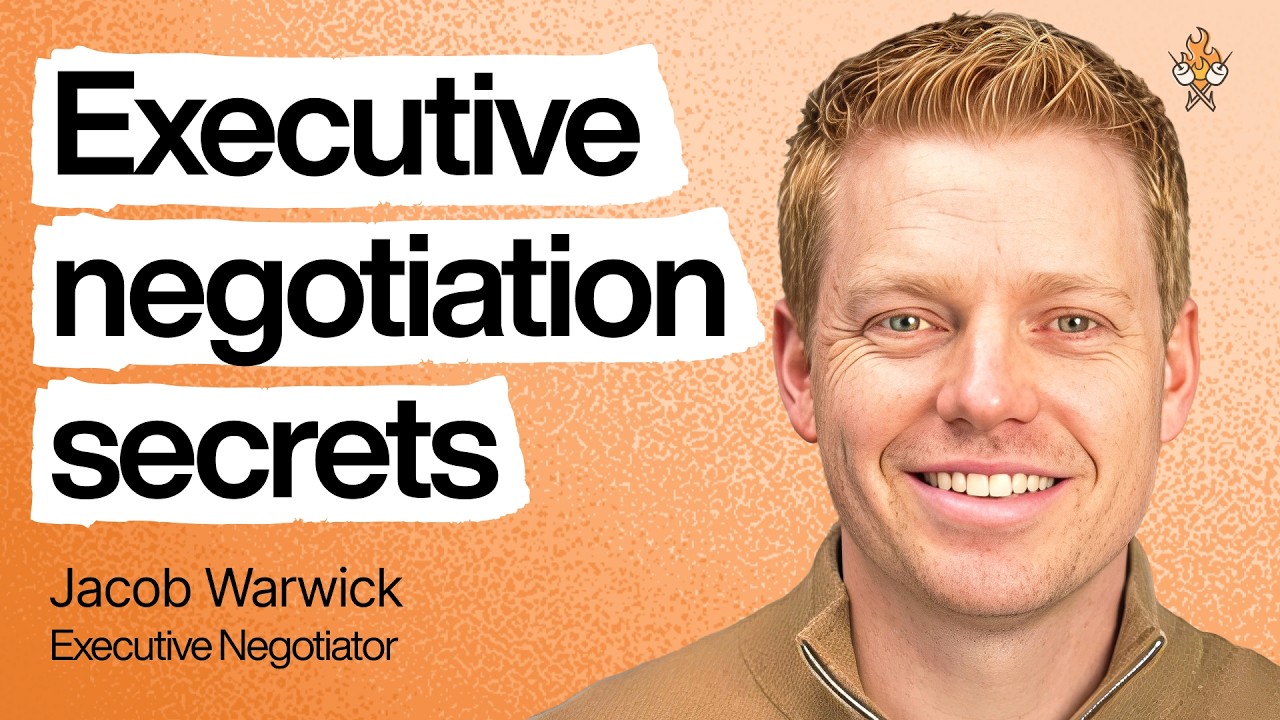
Jacob Warwick, a professional negotiator who has helped clients secure over $1 billion in additional comp, shares the psychology and tactics behind compensation negotiation. From s…
Why This Episode Matters
The 20-40% Gap
A simple pushback gets you ~20% more. With strategy, Jacob's clients average ~40% movement on initial offers.
It Starts Earlier Than You Think
Your LinkedIn profile, headshot, and first recruiter call are already negotiation. Most people don't realize it.
Sell the Vacation, Not Your Resume
Stop pitching credentials. Instead, walk the hiring manager into a future where their problems are solved — by you.
Collaboration, Not Confrontation
The best negotiations feel like brainstorming sessions. Make it about "we" not "me" — expand the pie instead of fighting for slices.
Information Is Power
Companies negotiate thousands of times a day. You negotiate 4-5 times in your career. The werewolf game explains why this matters.
Hollywood Meets Silicon Valley
From $5M→$22M movie deals to Marvel franchise spats, the psychology of negotiation scales across every domain.
The Money You're Leaving on the Table
Simple Pushback
Strategic Negotiation
Breaking Salary Bands
"those that challenge authority and challenge in a meaningful and collaborative way will win more than those that don't"
Real example: Three people in ranges of $185K-$285K landed at $1.1M after upleveling from Senior Director to VP. Two deals comped at $600K landed at $1.1M and $1.2M — doubled from initial offers.
The Value Exchange Is Never Fair
Companies extract 5x to 100x value from your work. You're developing products with infinite scalability — the company profits massively.
"usually a company is extracting much more value out of you naturally, like 5 to one, 10 to one, 100 to one"
The mindset shift: You're not being greedy by pushing back. The path to wealth is through ownership, and as a W2 employee, the exchange already favors the company.
For founders worried about this advice: The goal isn't to beat you up. It's performance-tied comp — people with skin in the game stick around longer.
The Biggest Mistake: Not Knowing When It Starts
Your Public Perception
Your LinkedIn profile, headshot, and narrative define how people see you. Jacob says he could predict someone's salary by the quality of their headshot — and it was "wildly consistent."
Recruiter Conversations Are Permanent
When a recruiter asks how much you expect, that number follows you. Jacob: a recruiter who heard "225" will offer you 225 again five years later, not recognizing your growth.
The Less You Share, The Better
When you're on the phone, you can correct the narrative and steer the conversation. But once you've shared a number or a title, you're anchored to it. Control the information flow from day one.
Never Negotiate Over Email
The #1 tactical mistake: hiding behind the easiest communication channel.
"If I push back and the CEO that reads it's in the airport security line and pissed off and they read it, they might be like, 'That bastard wants more money.'"
The telephone problem: Negotiating through recruiters is a game of telephone. You get the tone right, the recruiter relays it as "that bastard wants more money."
Who to negotiate with: Go to the person with skin in the game — who controls the P&L? That's who you want to talk to.
Home Field Advantage: Control Time & Place
Control the Environment
More deals are closed on the golf course than in boardrooms. Pull the conversation out of their office — coffee, lunch, a walk. Walking side by side is collaborative; sitting across is confrontational.
Control the Time
CEO wants to meet at 6 AM? Say no. Know when your body language is strongest. Jacob recommends: "I'm strongest between the hours of 10:00 a.m. and 1:00 p.m." — this also communicates scarcity.
The OpenAI Walk
Jacob's clients interviewing for C-suite roles at OpenAI would walk downtown San Francisco instead of meeting in the office. The real reason? The office was chaotic — but the side effect was better negotiation dynamics.
The Number Question: Who Speaks First?
The Deflection Script
Step 1: "I don't talk about compensation until we're ready to make an offer. I'd love the opportunity to learn more about the team."
Step 2 (if they push): "I'm uncomfortable doing that right now because I don't understand the scope of the role. Can you help me understand what you had in mind?"
Step 3: Turn the question back — "What did you have in mind?" flips the anchor to them.
Why This Works
Never be so sure of your worth that you wouldn't accept more. When you anchor, that becomes the ceiling. They'll naturally split the difference.
The key insight: "How much do you want to make?" is eerily similar to the illegal question "How much do you make?" — they just reword it.
If you must share a number, anchor egregiously high. Studies show those who anchored high won 75% more than those who tried to be reasonable.
Jacob's Origin Story: $14/hr to $120K in One Jump
Jacob was a marketing manager in San Francisco making $12/hour — didn't know that wasn't normal. Got promoted to Director at $14/hour. Then he saw marketing directors made $110K.
When a recruiter called and asked his salary, instead of revealing $14/hour, he asked: "What did you have in mind?" They said "$110 to $130K." He replied: "Oh, I'm on the upper end of that now."
Result: From $14/hour to $120,000/year in a single jump. One negotiation changed his life — and ignited his passion for this work.
Don't Anchor Too Early: The Scope Creep Trap
The Trap in Action
You anchor to "this is fair for a senior PM role." Then through interviews, the scope expands: lead five people, add a product-led growth motion, an engineering pod, more teams. Classic scope creep. When the offer comes in 20% under your original number, they say: "But you said you only wanted 140."
The Fix
Treat the process like an enterprise B2B sale. You are a multi-hundred-thousand-dollar consulting solution. You wouldn't pitch the price before discovery — so don't share your number before understanding the role.
The Reframe
"As we had this conversation, I'm likely a little more horsepower than you anticipated. What's the chance we can come in and restructure the comp for the type of talent we're bringing in here?"
The Interview Framework: Sell the Vacation
Jacob's approach to flipping interviews from interrogation to consultation:
Open with: "Some of the best interviews I've always had felt a little bit more like consultations or brainstorming sessions. Are you open to having a chat like that today?"
Then follow the 4-step discovery process →
The goal: By the end, you've collected all the information, they've revealed their pain, and you haven't discussed comp at all.
"fast forward 6 months from now and we're working on this problem together... when you head into that board meeting next, how can we ensure that your head is held high?"
The Spielberg Close: Act Like You Already Have the Job
The Setup
A director of a billion-dollar music tour was the hottest commodity in Hollywood. Every agency wanted to sign them. Most agencies pitched credentials: "We've represented Julia Roberts, Matt Damon..."
Jacob's insight: leaning on logic and credibility loses. You need to sell the future and own the emotion.
The Move
The director asked: "Why should I sign your agency?" Jacob's client responded: "What are you doing on Friday? I cleared a lunch with your assistant." He asked "Stephen who?" She said "Stephen Spielberg." Deal closed.
The Principle
"If you already had the job, who would you introduce him to?" — Don't pitch from the outside. Put yourself in the position that you're already doing the job.
The Werewolf Game: Information Asymmetry
Jacob uses the game of Werewolf to explain why information is the key to negotiation power.
In Werewolf, 2-3 players secretly know they're werewolves while 9-10 are villagers. Even outnumbered 5:1, werewolves win 60-70% of the time because they have more information.
The parallel: Companies negotiate thousands of times a day. You negotiate 4-5 times in your career. They know all salaries, budgets, and alternatives. You're the villager.
The upside: This should give you confidence to push back. You're already at a massive disadvantage — you have nothing to lose by trying.
The Three Pillars of Persuasion
Jacob is a big believer in Aristotle's principles of rhetoric — but warns that most executives lean too heavily on logic.
The mistake: Trained professionals default to credibility and logic because that's what corporate rewards. But the emotional side is where deals get unfair.
Tactical empathy: Give people a positive reputation they want to uphold. "I appreciate that you've always been an advocate for women and you support one another." Now they're trapped — they can't contradict that identity.
The fourth pillar — Timing (Kairos): Negotiation comes down to information and timing. That's what creates power.
"If You Were in My Shoes"
"If you were in my shoes, what would you do?"
When Negotiations Stall
"You know what's possible here. You know what levers we have. It sounds like we're capped out here. If you were in my shoes, what else would you explore?"
This forces them to advocate for you — they know the system better than you do.
For Gender Pay Gaps
When a female negotiator gets a lower offer from another woman: "I appreciate that you've always been an advocate for women... if you were in my shoes, what would you ask for?"
Uses shared identity + the positive reputation technique together.
Never Split the Difference
A Hollywood writer story that explains why "meeting in the middle" is lazy negotiating.
A writer had a $700K contract. Attorneys countered at $1.3M. Studio said "fine, we'll do a million." Settled at $1M.
The studio came up $300K. The attorneys lost $300K. They split right in the middle.
"if the attorneys said 1.5, would the deal have come in at 1.1? If the attorney said 1.7, would it have come in at 1.2?"
Jacob's verdict: "Those attorneys weren't aggressive enough. We didn't find the ceiling there, did we? That was lazy negotiating."
The Severance Story: "Was That a Mistake?"
The Setup
A Chief Revenue Officer was paid $350K base + $350K bonus = $700K on-target earnings. They negotiated six months of on-target earnings as severance. But the paperwork came back saying six months of base salary — cutting severance in half.
The Instinct (Wrong)
The CRO wanted to split the difference — propose something around $260K. Would have cost him ~$90K just from lazy negotiating.
The Fix (Right)
Jacob said: simply ask "Was that a mistake?" The CEO responded: "Oh yeah it must have been. Let me just tell the attorneys to fix it. Feel free to redline it."
Postscript: 12 months later, the CRO got fired — and recouped $350,000 over 6 months thanks to the corrected severance terms. That one question was worth six figures.
Performance-Based Triggers: Expand the Pie
The Tom Brady Model
Tom Brady's Tampa Bay contract: Win 8 games → $500K. Win 12 → $1.5M. Playoffs → bonus. Super Bowl MVP → $2.5M more. Performance-based triggers tied to real outcomes.
Apply to Tech
"If the company grows to 100 million ARR and I contributed this to it, what would that outcome look like?" Founders love skin in the game — it de-risks the hire.
Make It About "We"
"I'm not asking for you to take your pie and give them a bigger slice. I'm asking for you to work with somebody to expand the pie so everybody gets bigger slices."
The CMO Severance Story: Make the Company Look Good
The Situation
A CMO joins a $200M private company. CEO prides himself on equitable pay: everyone gets $340K base, 30% bonus, same equity. No room to push on cash.
The Move
Instead of negotiating personal severance (awkward — it's like negotiating divorce terms before the wedding), they proposed: "Wouldn't it make us look good to proactively give everyone on the executive leadership team six months severance to show that they're safe and committed?"
Fed the idea to the CEO so the CEO could look like the hero.
The Result
The CMO got her severance protection. But more importantly — every executive got it too. She walked in as "the woman that negotiated us all severance protections." She used the company's own equitable policies to expand the benefit for everyone.
When Things Go South: The Rescinded Offer
The Disaster
A CMO was offered an $800K contract. Her career coach told her to "negotiate like a white man" — be aggressive, demand your worth. Problem: she was negotiating with a female CEO and three other women on the leadership team. They rescinded the offer because she seemed like a bad cultural fit.
The Recovery
Jacob's advice: call the CEO, be honest. Share the identity: "it's important that women take care of each other... I got to be honest with you, I hired a coach... I made a mistake and I disagreed with the advice, but I did it anyway because I had to try."
Shared identity + extreme ownership + transparency brought the offer back on the table. She's now happily making $800K/year.
The lesson: There's no one-size-fits-all approach. Context matters — who you're negotiating with, the culture, the dynamics. Authenticity beats persona every time.
Gender, Culture, and the Rising Tide
An African-American woman asked Jacob: "Should we just negotiate for 84% because that's what we're going to get anyway?" His response to the room of mothers:
The Rising Tide Principle
"If companies want to rely on precedent, have the audacity to raise the precedent because the next people in line will" benefit. Every successful negotiation raises the bar for everyone who follows.
Context Sensitivity
Jacob takes a different approach for every person — gender, culture, location, background. "Whether you're a product leader or a marketing leader or a sales leader or you're from San Francisco or you're from Dubai... everybody is different culturally."
"a rising tide raises all ships... if we don't learn to grow together, we're never going to solve this problem"
Hollywood Scale: From $5M to $22M in Two Days
The Deal
An A-list celebrity was offered $5M for a movie. The attorney came back at $22M. The production company countered at $13M. They settled around $18M.
The Takeaway
Scale matters. Jacob puts it in perspective: a million seconds is 11 days. A billion seconds is 31 years. The discrepancy between small and big negotiations isn't linear — it's exponential.
The flip side: If you're making $18/hour and negotiate to $24, that's equally life-changing. Jacob remembers being homeless 12 years ago, fighting to pay for gas. The principles work at every level — the dollar amounts just change.
It's Not Always About Money
The Setup
A Marvel superhero actor clashed with the director/writer on the third installment of a franchise. The actor wanted the writer fired. A new writer came in — it was worse. Six months and millions in production delays later, they needed the original writer back.
The Agency's Instinct
"Throw money at this guy" — offer a million more dollars. But the writer was making $10M/year. A 10% bump to work with someone who insulted him? Not powerful enough.
Jacob's Suggestion
Ask the A-list celebrity to humble themselves and apologize. That's what moved the deal. The apology mended the relationship. The million dollars was saved.
"it's not always about money... that is what moved the deal across the line. Actually came in and apologized for the behavior."
The "Fingerprintless" Advisor Model
Jacob calls his approach "fingerprintless" — similar to an attorney, not a Hollywood agent. All correspondence goes through him before it reaches the other side.
1. Prepare
Client calls Jacob before any conversation. They strategize the game plan together.
2. Perform & Debrief
Client has the conversation, then reports back. They analyze what happened.
3. Draft Together
CEO sends an email → Jacob reviews it → they draft the response together, testing the client's instincts first.
Why slow down? "Haste equals risk." Taking days to respond communicates scarcity, shows thoughtfulness, and gives time to collect information and build a compelling case.
For Product People: You Already Know How to Do This
Product = Negotiation
You know that an inbound lead is easier to close than outbound. You understand user research, pain points, eliminating friction. A job search is the same product flow:
- Your buyer = hiring manager / CPO / CEO
- User research = discovery questions in interviews
- Friction elimination = making it frictionless to hire you
Don't Be Jacob
"Don't be Jacob Light. Be you, your authentic you, and apply it to what you already know." The early days of managing your career like a product will feel rough — like early days of writing PRDs. But 10 years in, it becomes second nature.
Build Champions
Like an enterprise sales process, build multiple champions inside the organization. Ask to talk to engineering, marketing, sales leads. "I'm making it frictionless across the process and I'm closing the next part of the conversation regardless of whether you wanted me to introduce me to those other people or not."
The Power of "No" and the G-Wagon
The Power Dynamic
If you have a job and your needs are met, you can say no — and that gives you infinite power. The nuance changes when you need the paycheck. This is why it's easier to find a job when you have one: your needs are met, so you negotiate more confidently.
The G-Wagon Story
A CEO had two identical offers at $2.4M. Both maxed out. Stalemate. Jacob jokingly asked what car she liked. "Mercedes." She mentioned it to the company. They said "Done. What model?" A $350K G-Wagon was added as a company write-off — 6,000lb vehicle tax deduction.
Predetermined? Not Your Outcomes.
"none of these outcomes are predetermined. No matter what situation you are in your life, how you were raised, it could be more difficult for you, but it's not predetermined"
Challenge Your Timelines
Jacob's favorite question: "What would that look like if it was done in one?" when someone says they want something in five years. Not to rush — but to challenge the ceiling you've set for yourself.
What Would Less Look Like?
Some clients have $10-15M in the bank and think they need $10-15M more to retire. Jacob challenges: "What would your life look like with less?" Sometimes the minimalist path is the answer.
The personal drive: Jacob felt powerless growing up. In the boardroom, he recognized the same fight-or-flight fear — but it was less scary. "All I ever wanted to do... was help that person feel safe." That childhood experience fuels his work today.
Jacob's Bookshelf & Tools
Recommended Books
- Influence by Robert Cialdini — "That's the one"
- You Can Negotiate Anything by Herb Cohen — dated but brilliantly simple, uses everyday examples like dishwashers
- Negotiation Made Simple by John Lowry — "this is what I wanted to write"
- Radical Candor by Kim Scott — gave Jacob "the confidence to be assertive in the ways that I never had been before"
Favorite Products
- Claude Code (referred to in the episode) — daily driver
- MacroFactor — macro tracking for nutrition
- Whoop — lost almost 50 lbs paying attention to sleep and stats
- Gemini — along with Claude Code, the two "winning the race" in his view
Life Motto
"Always give more than you expect to receive. It's like a golden rule plus plus."
Jacob's content rule: create 10x more content than you consume. He reads about one book a year — and his upcoming book "Predetermined" will be the output.
The Cystic Fibrosis Foundation
Jacob's son has cystic fibrosis — a genetic condition where life expectancy used to be 7-10 years. New medication has changed that expectancy from 7 to 70 years. He serves on the board of the Cody de Roof Foundation in Bozeman, Montana, helping rural communities access healthcare.
The Story That Got Him
A mother had three boys with cystic fibrosis. Her 29-year-old needed a lung transplant — she couldn't afford it, and he passed away. Two years later, her 27-year-old needed the same surgery. She found the foundation in time — they funded the Lifeflight to Denver Children's Hospital and saved his life.
The part that broke Jacob: the mother now carries guilt that she could have saved her first son if she'd known the foundation existed.
Within 24 hours of his son's diagnosis, Jacob's network delivered: calls from Denver Children's Hospital, Stanford, and the FDA. All those years of "give before you ask" came back when it mattered most.
核心金句
"what's the chance there's a little bit more"
— The simplest phrase that yields ~20% more
"Haste equals risk"
— Slow down, collect information, build your case
"If you're positioned as a commodity, you will be treated like a commodity"
— Your narrative defines your leverage
"never be so sure of your worth that you wouldn't accept more"
— Don't anchor yourself
"this is a collaboration not a confrontation"
— Great negotiators vs aggressive ones
"curiosity and empathy are the two things you need to have the most"
— More important than any framework
"if you're going to take a chance, take a chance on yourself"
— The bruises are worth it
Take a Chance on Yourself
"if you're going to take a chance, take a chance on yourself... you're only going to make life better around you"
Jacob Warwick · Execs and the City (Substack) · thinkwarwick.com