Why Most AI Products Fail
Ash and Kiriti share hard-won lessons from 50+ AI product deployments across OpenAI, Google, and Amazon. They break down why AI products are fundamentally different from traditional software (non-determinism + agency-control tradeoff), introduce their CCCD framework for iterative AI development, and argue that pain — not speed to market — is the real competitive moat.
Ash and Kiriti share hard-won lessons from 50+ AI product deployments across OpenAI, Google, and Amazon. They break down why AI products are fundamentally different from traditiona…
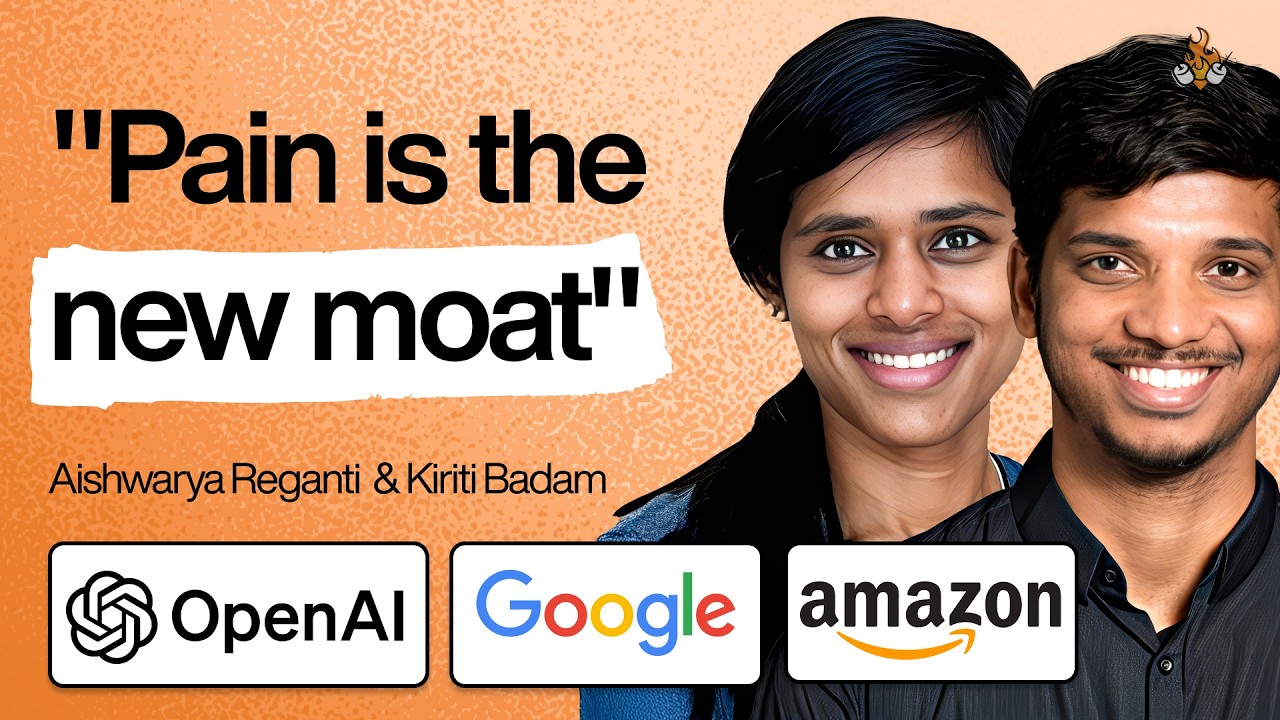
Why This Episode Matters
AI ≠ Traditional SW
Non-deterministic inputs AND outputs fundamentally change how you build
Agency-Control Tradeoff
Every bit of autonomy you give AI means control you give up — earn trust first
Start Small, Graduate
V1 → V2 → V3 progression keeps risk low while building flywheels
Evals Are Misunderstood
Neither evals nor production monitoring alone will save you — you need both
CCCD Framework
Continuous Calibration + Continuous Development: the AI version of CI/CD
Pain Is the New Moat
No textbook, no shortcut — the companies that iterate through pain win
Difference #1: Non-Determinism
Traditional software has a well-mapped decision engine — think booking.com where clicking through buttons always produces the same predictable experience.
AI products replace that with a fluid, natural-language interface. The user can express intent in countless ways, and the LLM — a probabilistic black box — can respond unpredictably.
Triple uncertainty: You don't know how the user will behave, you don't know how the LLM will respond, and you don't fully understand the process in between.
Ash: this is also the most beautiful part of AI — the bar to using AI products is much lower because you can be as natural as you would be with humans.
Difference #2: Agency-Control Tradeoff
"Every time you hand over decision-making capabilities to agentic systems, you're kind of relinquishing some amount of control on your end."
More agency = less control. You want to make sure the agent has earned trust before giving it the ability to make decisions.
Insurance example: MRIs and blood tests can be auto-approved (low risk), but invasive surgery pre-authorization needs a human in the loop (high risk).
Start Small: The V1 → V2 → V3 Progression
Coding Assistant
V1: Suggest inline completions and boilerplate snippets
V2: Generate larger blocks like tests or refactors for humans to review
V3: Apply changes and open PRs autonomously
Marketing Assistant
V1: Draft emails or social copy — "here's what I would do"
V2: Build a multi-step campaign and run it
V3: Launch, A/B test, auto-optimize across channels
Why this works: When you start small, it forces you to think about the problem you're going to solve, instead of getting lost in solution complexity.
Customer Support: A Real Example from OpenAI
V1: Routing
Agent classifies and routes tickets to the right department. Even if it routes wrong, humans can undo the action.
V2: Co-pilot
Agent generates draft responses based on SOPs. Humans review and edit before sending. You're logging what humans change — free error analysis.
V3: End-to-End
Agent drafts resolution AND resolves the ticket directly. Only after V2 proved drafts were mostly used as-is.
Cautionary tale: Ash worked on a customer support use case where they built the end-to-end agent from day one — they had to shut down the product because of too many hot fixes and emerging problems they couldn't keep up with.
Problem First, Not Solution First
"In all this advancements of the AI, one easy slippery slope is to keep thinking about complexities of the solution and forget the problem that you're trying to solve."
What Goes Wrong
- Companies get pressure from competitors building agents
- Teams try to build end-to-end autonomous agents on day one
- They get overwhelmed with 100 different failure modes
- Hot fixes pile up, product gets shut down
What Works
- Obsess over the business problem, not the technology
- Understand your workflows deeply before automating
- Choose the right tool for each part: ML model, deterministic code, or LLM agent
- Build flywheels that improve over time
Key stat: 80% of so-called AI engineers and AI PMs spend their time actually understanding their workflows, not building fancy models.
One-Click Agents? Pure Marketing.
"When someone comes up to me and says, 'We have this one-click agent. It's going to be deployed in your system and then in two or three days it'll start showing you significant gains,' I would almost be skeptical because it's just not possible."
Enterprise data is messy. Hierarchical taxonomies are broken, there are duplicate functions named "get customer data w1" and "w2", and there's massive tech debt the agent needs to navigate.
Real human agents know hidden rules — like checking if a taxonomy node was last updated in 2019, meaning it's dead and should be ignored. These rules are nowhere in documentation.
Ash's advice: Go with a company that says "we're going to build this pipeline for you and it will learn over time" — not one promising out-of-the-box results. Building significant ROI easily takes four to six months.
The AI Success Triangle
Leaders: Must relearn intuitions built over 10-15 years. Be hands-on. The Rackspace CEO blocked 4-6 AM daily for "catching up with AI."
Culture: Build empowerment, not FOMO. Subject matter experts are crucial — but they won't help if they think they're being replaced.
Technical: Understand your workflows obsessively. Choose the right tool for each sub-problem, not just "slap an agent on it."
Leaders Must Relearn Their Intuitions
"You must be comfortable with the fact that your intuitions might not be right and you probably are the dumbest person in the room and you want to learn from everyone."
Why It's Hard
- Leaders have built intuitions over 10-15 years
- Those intuitions are highly regarded — but now may be wrong
- It's almost always impossible for AI adoption to be bottom up
- Engineers can't get buy-in from leaders who don't trust the technology
What Great Leaders Do
- Block dedicated time for learning AI (like the 4-6 AM block)
- Run weekend white-coding sessions
- Consult 2-3 trusted sources, then bounce questions off AI experts
- Understand the range of what AI can solve — not just assume it's easy or impossible
Ash: "I've heard from so many folks who are building that our leaders just don't understand the extent to which AI can solve a particular problem, or they just white-code something and assume it's easy to take to production."
Culture: Empowerment, Not Replacement
The FOMO Problem
Companies create a culture of "you will be replaced" — subject matter experts get afraid and refuse to collaborate. But SMEs are critical for building AI products that actually work, because you need them to define ideal behavior and validate outputs.
The Empowerment Alternative
Frame AI as augmenting what people already do. Make the entire organization feel they're "in it together." AI opens up more opportunities — employees can 10x their productivity instead of losing their jobs.
Real story: A new hire built his own vibe-coded app to replace a popular paid task tracker and onboarded the whole team. That kind of agency — rethinking experiences instead of accepting the status quo — is what sets people apart.
Flywheel Thinking: Build to Improve Over Time
"It's not about being the first company to have an agent among your competitors. It's about have you built the right flywheels in place so that you can improve over time."
The Flywheel
- Deploy a constrained AI system
- Log human behavior and corrections
- Analyze error patterns
- Feed insights back into the system
- Gradually increase autonomy
- Repeat
Why This Beats Day-One Autonomy
- Air Canada incident: Agent hallucinated a refund policy that wasn't in the playbook — company had to honor it due to legal implications
- 75% of enterprises surveyed said their biggest problem was reliability — that's why so many AI products today are productivity tools, not end-to-end agents
- You're building implicit logging for free when humans review AI outputs
The Evals Debate
Evals = your trusted product knowledge encoded as test datasets. They catch errors you already know about.
Production monitoring = implicit + explicit signals from real users. Catches emerging patterns you never predicted.
The false dichotomy: Eval will solve everything vs. production monitoring will solve everything. Neither is true.
Example: In ChatGPT, if a user regenerates an answer instead of giving a thumbs down, that's an implicit signal that the answer wasn't meeting expectations.
"Eval" Has Lost Its Meaning
"Martin Fowler at some point had this term called semantic diffusion... someone comes up with a term, everybody starts butchering it with their own definitions, and then you kind of lose the actual definition of it. That is kind of what is happening to eval."
Data Labelers Say "Eval"
PMs Say "Eval"
Clients Say "Eval"
The real question everyone agrees on: Is it important to build an actionable feedback loop for AI products? Yes. How you do that depends entirely on your application.
How OpenAI Codex Approaches Evals
Coding agents are uniquely hard to eval
They're built for customizability, used in countless integrations and workflows. It's nearly impossible to build eval datasets covering all possible interactions.
The Codex approach
- Core eval datasets to ensure changes don't damage critical product functionality
- Extreme focus on understanding how customers use the product
- A/B testing for major changes (like the code review product)
- Active social media monitoring for user problems
- Each engineer maintains their own hard problems list and tests new models against it
The Claude Code counterpoint
Boris, head of Claude Code, said they don't do evals — it's all vibes. Kiriti's take: nobody can claim one concrete set of evals they can bet their life on. Every new model launch means the team gets together and tests different things.
The CCCD Framework
Continuous Calibration, Continuous Development
Continuous Development (right side): Scope capability → curate data → set up application → design eval metrics → deploy
Continuous Calibration (left side): Spot error patterns → analyze behavior → apply fixes → design NEW eval metrics → feed back
Key insight: Eval metrics only catch errors you're already aware of. Calibration catches the emerging patterns you never predicted.
CCCD: When to Level Up
"It's all about minimizing surprise — when you're not seeing new data distribution patterns and your users have been pretty consistent, the amount of information you gain is very low. That's when you know you can go to the next stage."
Signs You're Ready
- No new data distribution patterns
- Users behave consistently with the system
- Low information gain from each calibration cycle
- Drafts are being used as-is most of the time
Events That Reset Calibration
- Model changes (GPT-4o deprecated → GPT-5 has very different properties)
- User behavior evolves over time (people don't talk to ChatGPT the same way they did two years ago)
- Users discover new use cases and push the system beyond its design
The Underwriter Story: Users Will Surprise You
The System
Built for a bank to help underwriters find policies and information to approve loans. Loan applications were 30-40 pages long.
The Success (First 3-4 Months)
Underwriters reported real productivity gains. The system worked great for its intended purpose — retrieving relevant policies and bank information.
The Surprise
Users got excited and started asking deep questions they never anticipated: throwing entire application documents at the system asking "for a case that looks like this, what did previous underwriters do?" — a natural extension for the user, but required completely different capabilities to build.
Lesson: What seems natural to an end user might be very hard to build. User behavior evolves over time, and that's when you know you need to recalibrate.
Multi-Agents: Misunderstood, Not Overrated
The Misconception
People think: "I have this incredibly complex problem. I'll break it into agents — you handle this, you handle that — connect them all, and it's agent utopia." Letting agents communicate peer-to-peer in something like a gossip protocol doesn't work with current model capabilities.
What Actually Works
Supervisor + sub-agent pattern: One orchestrating agent delegates to specialized sub-agents. This keeps control centralized and guardrails manageable. The alternative — dividing by functionality and hoping they coordinate — is incredibly hard, especially in customer-facing use cases.
Coding Agents Are Underrated
Kiriti: "Talking to an engineer in any random company, especially outside of Bay Area, the amount of impact coding agents can create — and the penetration is very low." 2025-2026 will be huge for coding agent adoption.
2026 Predictions
Kiriti: Proactive Agents
Background agents that understand your workflow, get plugged into where actual work happens, and prompt YOU back.
Example: A coding agent that says "I have fixed five of your Linear tickets — here are the patches, just review them at the start of your day."
The reason AI is failing to create value today is mainly about not understanding the context. As agents get plugged into the right places, they'll start to see the world around you.
Ash: Multimodal Experiences
As humans, we are multimodal — language is probably one of our last forms of evolution. When we talk, we're constantly picking up signals (nodding, boredom) and adjusting.
Two opportunities:
- Better human-AI interaction — richer than just text
- Tons of "boring tasks" with handwritten documents and messy PDFs that can't be parsed by even the best models today — multimodal understanding unlocks that data
Design > Implementation
"Building is really cheap today. Design is more expensive. Really thinking about your product, what you're going to build, is it going to really solve a pain point — that is what is way more valuable today."
Ash's advice: Implementation is going to be ridiculously cheap in the next few years. Nail down your design, your judgment, your taste.
Career implication: The first 2-3 years used to focus on execution mechanics. Now AI helps you ramp quickly. What matters is taste, judgment, and what is uniquely you.
Pain Is the New Moat
"Successful companies right now building in any new area — they are going through the pain of learning this, implementing this and understanding what works and what doesn't work. Pain is the new moat."
What the Moat Looks Like
- Understanding non-negotiable trade-offs for your specific domain
- Matching model capabilities to actual problems through iteration
- Building lived experience across the organization
- Creating eval datasets and flywheels that took months of pain to develop
Why There's No Shortcut
This is a three-year-old field. There are no playbooks, there are no textbooks. The knowledge you build through iteration — that pain — is what translates into the moat of your company.
Lenny's reaction: "It's like turning a coal into diamond."
The Closing Word
"Be obsessed with your customers. Be obsessed with the problem. AI is just a tool."
80% of so-called AI engineers and AI PMs spend their time actually understanding their workflows very well — they're not building the fanciest models, they're in the weeds understanding customer behavior and data.
Whenever a software engineer who's never done AI before hears "look at your data" — it's a huge revelation, but it's always been the case. Go there. Look at your data. Understand your users.
Core Quotes
"Every time you hand over decision-making capabilities to agentic systems, you're kind of relinquishing some amount of control on your end."
— Ash
"It's not about being the first company to have an agent among your competitors. It's about have you built the right flywheels in place so that you can improve over time."
— Ash
"If someone's selling you one-click agents, it's pure marketing."
— Ash
"Building is really cheap today. Design is more expensive."
— Ash
"Pain is the new moat."
— Kiriti
"Be obsessed with your customers. Be obsessed with the problem. AI is just a tool."
— Ash
"Pain is the new moat."
Aishwarya Sranti & Kiriti Bottem · Lenny's Podcast
Course: Building Enterprise AI Products (Maven)
Ash: LinkedIn · 20K-star AI learning GitHub repo
Kiriti: Codex at OpenAI · LinkedIn